Spaceflight Now | Breaking News | Hubble sees comet ISON bringing holiday fireworks.
Tag Archives: comet ison
Comet Ison brightening fast
Per catholic.org
Comet ISON is still aiming for a spectacular showing this November as the comet continues to brighten rapidly. The celestial visitor is now between the orbits of Mars and Jupiter and may become one of the brightest natural objects seen in the nighttime sky.

LOS ANGELES, CA (Catholic Online) – The Hubble Space Telescope has been following Comet ISON, formally designated C/2012 S1 (ISON) or Comet Nevski-Novichonok. The media continues to refer to it as ISON because of its easy pronunciation and ready recognition.
Comet ISON is about 3.1 miles in diameter and traveling at a speed of 48,000 MPH. The comet is being watched by an increasing number of instruments as it brightens. Large, professional telescopes on Earth are tracking the object as well as space telescopes and major observatories.
By September, the comet should brighten enough to be spotted with most backyard telescopes and large binoculars. Eventually, the comet will be visible to the naked eye in November.
After that, it will continue to brighten as it rounds the sun on November 28, although it may not survive this approach, passing just 1.1 million miles from the surface of the Sun. At that close proximity, scientists think the comet could break into pieces.
Assuming ISON survives, it will remain visible on its outbound journey, with naked-eye observers enjoying the sight until mid-January. It should be easy to spot in telescopes until March.
On the night of January 14-15, Earth will pass close to ISON’s orbit, and may be dusted with fine particles from the comet. These particles are thought to be too small to spark a meteor shower that will be visible to the naked eye, but the dust could create high-altitude clouds that glow after sunset because of their height above the Earth’s surface. These are known as noctilucent clouds.
Comet ISON is expected to put on a spectacular show, even if it breaks up near the Sun. The current rate of brightening is on track for a -17 magnitude performance, which would make it brighter than the full moon. However, scientists think this pace of brightening may slow as it approaches the Sun, and it’s more realistic the comet will peak around -7 magnitude, which is closer to Venus in brightness. Experts warn that comets can often perform well below expectations, so betting on its performance is more guesswork than science.
Other questions remain about ISON. For example, its orbit appears to be very similar to that of the Great Comet of 1680, which was itself visible in the daytime sky. Astronomers have suggested that ISON may be a fragment of this comet, or rather than both comets share a common parent.
It is hoped that the appearance of Comet ISON will awaken imaginations around the world, and pique interest in astronomy for a new generation.
Will Comet ISON live up to it’s potential?
Scientists around the world have been tracking the promising Comet ISON because of its potential to star in a spectacular celestial show later this year, but from now through Aug. 8 the comet is on a “summer sabbatical.”
Comet ISON — which some have hailed as the next “comet of the century” — is currently located too near the sun to be seen from Earth. Since June 22, the comet has been less than 18 degrees from the sun and therefore cannot be seen against a dark sky. Your closed fist held at arm’s length covers about 10 degrees of the sky.
Currently located against the stars of the zodiacal constellation of Gemini, or the twins, the comet is progressing slowly eastward and will cross over into the boundaries of Cancer, the crab, on Aug. 1. A week later, on Aug. 8, the comet will have moved out as far as 18 degrees from the sun and once again will be evident against a dark sky. [See Photos of Comet ISON in Night Sky]
Comet ISON has brightened little, if at all, since the start of 2013, and when last seen was hovering at magnitude 15.5, making it nearly 4,000 times too dim to be seen with the unaided eye.
To readily observe the dim, fuzzy blob of ISON prior to June 22, you would have needed a very dark sky and a telescope with at least 20 inches (50.8 centimeters) of aperture, if not more. Comet ISON is too close to the bright twilight, but that will change after the first week of August as ISON — then a morning object — begins a slow emergence into the morning sky.
.”View gallery

This NASA Hubble Space Telescope image of Comet ISON was taken on April 10, 2013, when the comet was …
Both amateur and professional astronomers will have their fingers crossed that by early August ISON will have shown significant brightening since it was last seen in late June.
Mercury will be passing 4 degrees south of the comet on Aug. 8 and might be used to steer an observer toward ISON. But, by then, the comet will still be rather faint — probably about magnitude 13, although it might reach to magnitude 11 or even 10 by the end of August. Astronomers use a number-based magnitude scale to determine the brightness of objects in the night sky. The lower the magnitude number, the brighter the object.
With Comet ISON’s brightness apparently stalled as it disappeared into the glare of the sun, it’s anybody’s guess just how bright the object will shine when it reappears in early August.
The unpredictability of how bright a new comet may appear or how bright it ultimately gets is no surprise to those who constantly study these enigmatic objects. There are many variables that go into determining what ultimately will be seen: the comet’s orbit; the relative positions of the sun, Earth and comet; and, of course, the size and composition of the icy chunk of material that forms the comet’s nucleus.
.”View gallery
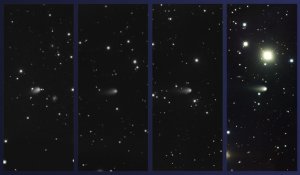
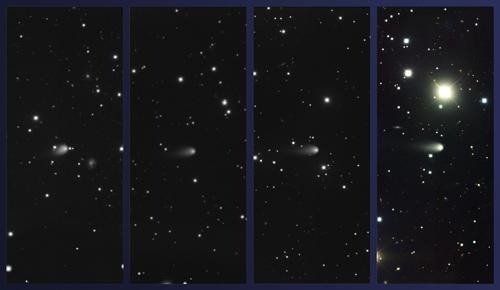
Images of Comet ISON obtained using the Gemini Multi-Object Spectrograph at Gemini North on February …
One reason it’s so hard to predict a comet’s brightness is that the material expelled from the object’s nucleus usually comes in distinct, albeit non-uniform jets or emissions. From more than a century’s worth of observations, astronomers have developed general formulas and models for comet brightness based on the observed behavior of literally hundreds of comets.
But some comets, like people, have their individual quirks.
It is hypothesized that ISON appeared abnormally bright during its discovery by amateur astronomers in September 2012 because it possessed a thin “frosting” of volatile material that vaporized at a great distance from the heat of the sun. This may have initially given a false impression that the object was dynamically large and active. After the frosting evaporated, the comet stopped brightening.
As to what happens next, observers now must wait until the comet gets close enough to the sun for any frozen water locked within its 3-mile-wide nucleus to begin to sublimate (go from a solid to a gaseous state). This, in turn, could “kick start” ISON back on a brightening trend.
ISON will need to come to within 230 million to 280 million miles (370 million to 450 million kilometers) of the sun for this to happen, but the comet won’t arrive within this distance range until July 8 to Aug. 12.
By the latter date, ISON will have emerged into a dark sky and will again be assessable to observers, low in the east-northeast sky, just before the break of dawn.
Will it have brightened or will it still be “stuck?” Observers will just have to wait and see.
Joe Rao serves as an instructor and guest lecturer at New York’s Hayden Planetarium. He writes about astronomy for Natural History magazine, the Farmer’s Almanac and other publications, and he is also an on-camera meteorologist for News 12 Westchester, N.Y. Follow us on Twitter, Facebook and Google+. Original article on SPACE.com.
Comet ISON news 6-27-2013
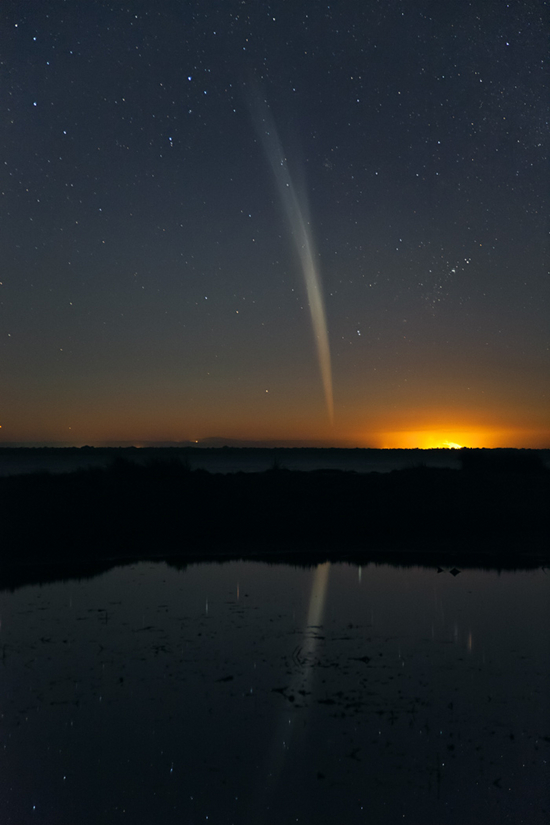
Here are the back-of-the-envelope numbers for June 27, 2013.
Today, Comet ISON is approximately 3.16 AU from the sun. There are still 154 days until Comet ISON reaches perihelion.
Over the course of the past 10 days, Comet ISON traveled a distance of approximately 0.135 AU.
0.135 AU = 12,549,034 mi
0.135 AU = 20,195,712.5 km
That’s an average speed of roughly 1.25 million miles per day, or 2.02 million kilometers per day.
Between June 26, 2013 and June 27, 2013, ISON traveled a distance of approximately 0.013 AU. This is fairly consistent with the numbers seen 10 days ago.
0.013 AU = 1,208,425.49 mi
0.013 AU = 1,944,772.32 km
That’s an average speed of roughly 50,351 mph or 81,032 km/h. That’s approximately 13.99 mi per sec or 22.51 km per sec.
Here are two news snippets from the past week.
Astronomers had predicted Comet ISON would have started to brighten by now but it has stayed constant. Right now the comet is out of observation range behind the sun in the asteroid belt. When observations begin again in August, astronomer David Schleicher explains they can see if it has brightened as expected.
– Arizona Daily Sun, June 22, 2013
Geoff Chester, a spokesman for the U.S. Naval Observatory in Washington D.C. said: “Predicting a comet’s appearance five months before it arrives is like predicting November’s weather now. There’s a lot of room for error, so it may be wise to acknowledge you don’t really know.”
– The News-Times, June 21, 2013
Big sun-diving Comet ISON might be spectacular in late 2013 | Space | EarthSky


Comet ISON, Comet of the Century: 10 Things to Know about ‘Comet of the Century’ – International Business Times
I’m eagerly awaiting this one. Hope it produces!!
 Talia's World