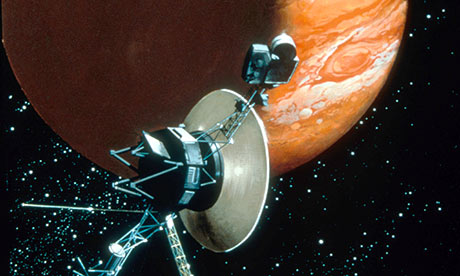
Voyagers 1 and 2

2007-0514voyager


Most people reading this blog are probably younger than I am and haven’t heard of the Voyager program. They were a pair of probes launched in the mid 1970’s, each powered by a small reactor, that have explored the Outer Solar System and now are headed for interstellar space.

This is a link to images of Voyager and what it’s taken of the planets Jupiter, Saturn, Uranus and Neptune. It’ll be informative and enjoyable to see what mankind has accomplished.

http://voyager.jpl.nasa.gov/imagesvideo/imagesofvoyager.html


Voyager 1 spacecraft’s latest find takes the edge off the solar system

voyager-space


per:

http://www.guardian.co.uk/science/2013/jul/09/nasa-voyager-solar-system-edge


The edge of the solar system has no edge, it turns out. It has a fuzzy transitional area, not quite solar system and not quite interstellar space.

This basic fact of our star’s environment has been discovered byVoyager 1, one of the most remarkable spaceships ever built. Our premier scout of deep space, Voyager 1, is currently 11bn miles from the sun, beaming data to Earth as it scoots at 24,000kmph toward the constellation Ophiuchus.

Scientists had assumed that Voyager 1, launched in 1977, would have exited the solar system by now. That would mean crossing the heliopause and leaving behind the vast bubble known as theheliosphere, which is characterised by particles flung by the sun and by a powerful magnetic field.

The scientists’ assumption turned out to be half-right. On 25 August, Voyager 1 saw a sharp drop-off in the solar particles, also known as the solar wind. At the same time, there was a spike in galactic particles coming from all points of the compass. But the sun’s magnetic field still registers, somewhat diminished, on the spacecraft’s magnetometer. So it’s still in the sun’s magnetic embrace, in a sense.

This unexpected transitional zone, dubbed the “heliosheath depletion region,” is described in three new papers about Voyager 1 published online last month by the journal Science.

“There were some surprises,” said Ed Stone, who has been the lead scientist of Nasa‘s Voyager program since 1972. “We expected that we would cross a boundary and leave all the solar stuff behind and be in all the interstellar stuff. It turned out, that’s not what happened.” So, how big is this transitional zone at the edge of the solar system?

“No one knows,” said Stone, 77, a professor of physics at the California Institute of Technology and the former head of NASA’s Jet Propulsion Laboratory, Voyager’s home base. “It’s not in any of the models. We don’t know. It could take us a few more months, it could take us several more years to get through it.”

The dimensions and nature of the heliosphere are not a wholly esoteric matter. The sun’s magnetic field deflects much of the radiation coming from other parts of the galaxy that was created in supernova explosions. Interstellar space is not a benign environment. The heliosphere’s features make life easier for blue planets such as Earth.

Voyager 1 can be counted as one of the great exploratory craft in history, and none has gone farther, nor cruised steadily at such astonishing speed (a few have briefly gone faster while falling into the sun). Two Voyager probes were launched in 1977. Both spaceships carried a gold-plated record crammed with digital information about human civilization, including mathematical formulas, an image of a naked man and woman, whale vocalizations, and clips of classical and rock-and-roll music. (The famous joke was that the aliens listened to the record and replied, “Send more Chuck Berry.”)

The two Voyagers embarked on what was called the Grand Tour, taking advantage of an orbital positioning of the four outer planets that happens less than once a century. Voyager 1 flew by Jupiter and Saturn before angling “north,” as astronomers would describe it. (There’s no up or down in space, but there is a north or south relative to the orbital plane of the planets.) Voyager 2 went past Jupiter and Saturn and flew by Uranus and Neptune before heading “south.”

The images of those planets and their moons, now taken for granted, were stunning triumphs of the Voyager mission. And in 1990, Voyager 1, nearly 4 billion miles from the sun, turned its camera toward Earth and took an image of what Carl Sagan called the “pale blue dot” of our home planet.

Now Voyager 1 is 124 astronomical units from the sun – one AU being roughly the mean distance from Earth to the sun, or about 150m kilometres. Voyager 2 is at 102 AU.

These spacecraft are not immortal, even if sometimes they act like it. They have a power supply from the radioactive decay of plutonium-238, which generates heat. The half-life of that system is 88 years. Small thrusters occasionally are fired to keep Voyager 1’s 23-watt radio antenna pointed toward Earth, where the faint signals are picked up on huge arrays of radio telescopes in the United States, Spain and Australia. But Stone anticipates that weakening power will force scientists to start shutting down scientific instruments on Voyager 1 in 2020 and that by 2025, the last instrument will be turned off.

“It changed the way we view our place in the cosmos,” said Bill Nye, the “Science Guy” who is chief executive of the Planetary Society in Pasadena, Calif. He said the new discovery by Voyager 1 is a classic example of why we explore: “What are you going to find over the unknown horizon? We don’t know. That why we explore out there.”

NASA’s associate administrator for space technology, Michael Gazarik, said of Voyager 1’s durability: “It is amazing, especially in the harsh environment of space. This piece of hardware has a life of its own.”

In 40,000 years, Voyager 1 will be closer to another star (with the romantic name AC+79 3888) than to the sun. And then what? It will just keep going – a silent, dark craft on a seemingly eternal journey.

“It will be orbiting the center of the Milky Way galaxy essentially for billions of years, like all the stars,” said Stone of what has been, for him, the spacecraft of a lifetime.

Could the Ender’s Game boycott actually sink the movie?

k-bigpic


http://io9.com/could-the-enders-game-boycott-actually-tank-the-movie-749408769


Usually when people organize a boycott of a big Hollywood movie, you sort of assume they’ll barely make a dent. But with Ender’s Game, it actually seems somewhat possible that the fan boycott of the film could generate enough static to keep the studio from getting the word out.

A bit of backstory: Ender’s Game is a classic 1985 novel by Orson Scott Card, about a war between humans and insectoid aliens, known as the Formics or “Buggers.” The book has won tons of awards, and is considered a major classic of the genre. In the nearly three decades since writing Ender’s Game, Card has established himself as a leading critic of same-sex marriage, and has advocated for laws against homosexuality.

Over the years, Card’s homophobic views have caused an uproar — most notably when he wrote a weird gay-baiting version of Shakespeare’s Hamlet and when the artist on his Superman comic quit to avoid controversy over his views.

But it wasn’t until recently, with a huge budget movie of Ender’s Game coming this fall, that Card’s opinions on homosexuality have become more of an issue. A group called Geeks OUT has started a campaign called Skip Ender’s Game on the grounds that if you buy a ticket to the movie, you’re putting money in Card’s pockets. This boycott was already getting a lot of attention, when Card threw gasoline on the fire by issuing a bizarre statement claiming that homosexuality wasn’t an issue in 1985, and boycotting his work is a sign of intolerance.

All of which makes me wonder: Is this controversy going to make it hard to get mainstream audiences to pay attention to the film? To be successful, an Ender’s Gamefilm has to reach beyond fans of the books, and if the movie is remotely close to the subject matter of the book, then there are going to be some themes and ideas that will freak out a lot of mainstream audiences. Reading from this book has already gotten one middle-school teacher in trouble.

Even by itself, a movie about space seems to be a hard sell these days — and we’ve seen plenty of other similar movies lose out lately, because mainstream movie audiences just couldn’t get interested in them. So it seems entirely possible that the mainstream media will be too busy debating Card’s views, and moviegoers will come away with a vague sense that this is a movie about gay-bashing. (The fact that the aliens are called “Buggers” probably does not help.) In today’s crowded movie marketplace, it seems like you have a brief chance to get people’s attention and sell them on your film — and if there’s any narrative out there that confuses the issue, you’re probably doomed.

If that does happen, of course, it won’t be the boycott organizers’ fault — it’ll be Card’s. He absolutely has the right to express unpopular or extreme views, but he also has to take the consequences. He wouldn’t be the first artist whose work was ignored or marginalized because of extremist political opinions, and in this case it’s hard to feel sorry. On the other hand, this could be another nail in the coffin of us getting interesting, challenging space opera on the big screen.

As to whether you should join the boycott — that’s absolutely a personal decision, and probably depends on how much you’re able to separate the author from his work. There are some pretty good thoughts on the subject in this comment from dlomax, however.

Lionsgate responds to calls for ‘Ender’s Game’ boycott

Per USAToday.com


Lindsay Deutsch, USA TODAY5:09 p.m. EDT July 12, 2013


Studio does not support author Orson Scott Card’s anti-gay stance but says it has nothing to do with the film.


Lionsgate is responding to what could be a potentially potent publicity problem for its upcoming fall sci-fi blockbuster, Ender’s Game.

Calls to boycott the film have popped up online because Orson Scott Card, the author of the 1985 book series Ender’s Game on which the movie is based, is publicly anti-gay and anti-same-sex marriage. The movie, starring Harrison Ford, is due out on Nov. 1.

“As proud longtime supporters of the LGBT community, champions of films ranging from Gods and Monsters to The Perks of Being a Wallflowerand a company that is proud to have recognized same-sex unions and domestic partnerships within its employee benefits policies for many years, we obviously do not agree with the personal views of Orson Scott Card and those of the National Organization for Marriage,” Lionsgate wrote in a statement. The studio pledged to host a benefit premiere for Ender’s Gamesupporting LGBT causes.

Recently, a group called Geeks OUT released its plans to boycott Ender’s Game, distributing a quote Card wrote in 1990 advocating “laws against homosexual behavior should remain on the books,” and exposing his role as a board member of the anti-same-sex marriage organization National Organization for Marriage.

On Monday, Card released a statement to Entertainment Weekly, saying, “With the recent Supreme Court ruling, the gay marriage issue becomes moot… Now it will be interesting to see whether the victorious proponents of gay marriage will show tolerance toward those who disagreed with them when the issue was still in dispute.”

Statements from both Lionsgate and Card reiterate that the stance has nothing to do with Ender’s Game, which is about child soldiers in space.

“The simple fact is that neither the underlying book nor the film itself reflect these views in any way, shape or form. On the contrary, the film not only transports viewers to an entertaining and action-filled world, but it does so with positive and inspiring characters who ultimately deliver an ennobling and life-affirming message,” Lionsgate wrote in the statement.

It’s not the first time that Card has come under fire for his anti-gay beliefs. In March,DC Comics caused fan furor for choosing Card to contribute to its Adventures of Superman anthology. A petition garnered more than 18,000 signatures, and the illustrator of the series, Chris Sprouse, left the project because of the controversy.