
guru.bafta.com

Words by Matthew Bell
This year’s Special Award recipient was never in any doubt about what he wanted to be when he grew up. As a child, he loved TV’s Doctor Who and devoured Arthur Conan Doyle’s Sherlock Holmes books. He even wrote his own version of Robert Louis Stevenson’s novella Jekyll and Hyde.
“I never really had any other ambition and I was always very clear that I wanted to be a scriptwriter,” reveals Steven Moffat, who, of course, went on to write Doctor Whoand Jekyll, and create (with Mark Gatiss) Sherlock.
Moffat‘s big break in TV came in 1989 on ITV’s BAFTA-winning teen drama, Press Gang, for which he wrote all 43 episodes. More than two decades later, having penned hundreds of hours of drama, this most prolific of writers is now the showrunner (creative head) of the BBC’s two biggest dramas, Doctor Who and Sherlock.
Moffat’s early work mined his own experiences: a stint as a teacher for Press Gang and BBC1 school-based farce Chalk; and the ups and downs of his relationships in the BBC sitcoms Joking Apart and Coupling. Is it important to write about what you know? “I was a teacher once so I wrote about teaching; I was going through the terror and the triumph of dating so I wrote about that,” he replies.
“Every writer writes about what they’ve personally been through, just because that’s what’s to hand. I don’t know if it’s an important rule of thumb – you should tell the story that most animates you. But I think it’s important to not make a mistake like writing Chalk,” he adds.
“Chalk didn’t work, although there were some very good people involved,” Moffat recalls. The early signs were promising. “Of any sitcom I’ve ever witnessed being made, and I’ve seen loads of them like Men Behaving Badly and The Vicar of Dibley,Chalk had the biggest laughs on the night. As a piece of theatre it was brilliant in the studio – people came back every week; the audiences were rapturous. The trouble was when I watched the tape at home, it was far too loud and raucous [for TV],” he says.
“The second series was commissioned before the first went out and they didn’t have time to cancel it. There’s no feeling on earth like working on a show that you know is doomed and already tanking.”
“I’ve always been much more passionate about television than movies and I don’t particularly want to be a foreigner. I‘d rather work here – working in British television is pretty cool.”
Writing comedy is a tricky business. Coupling, which followed Chalk, was a hit with both critics and viewers. Yet while making it, Moffat had a few shaky moments. “When we filmed the best ever show we did for Coupling – half of which was in Hebrew – the audience kept leaving on the night; I was barely getting laughs at all,” he recalls. “We moved the episode later in the run because we assumed that it was terrible, but when it came out it was the show that put us on the map.”
When Coupling ended after four series, Moffat jumped genres, writing episodes for the regenerated Doctor Who, including ‘Blink,’ which won him a BAFTA in 2008, and a modern-day version of Jekyll for BBC1.
“After many years of doing comedy, and rather farce-based comedy at that, it looks like a leap, but it didn’t particularly feel like one,” he recalls. “People talk grandly about range, but the truth is that you’re just writing.”
As a writer, Moffat prefers the end result to the process: “I love having written and getting a good show out there. I think it would be overstating things a little to say I love the actual writing.”
His advice to would-be scriptwriters is “just write. The big break is easy if you’re good enough. I hear people saying, ‘I’m desperate to write – I’ve written this script.’ And I want to say: ‘Why haven’t you written 50 scripts?’
“The first 50 will be shit and so will the next 50 and probably the 50 after that,” he continues. “You have to write all the time and not worry so much about going to the right parties or the contacts you have in the business – they’re completely irrelevant. And stop badgering people for advice because there almost is none – If you write a truly brilliant script, it will get on the telly.”
Doctor Who returns this autumn and Sherlock next year, and Moffat has no plans to move on. “The moment it’s time to stop on a show is not an ambiguous feeling – you just suddenly think, ‘I can’t do it anymore; I’ve had enough’,” he says.
Moffat has dipped into Hollywood, co-writing the screenplay for Steven Spielberg’sThe Adventures of Tintin: “I left it early and handed over to Edgar [Wright] and Joe [Cornish] – I ran away from LA to Cardiff to do Doctor Who, which is an unusual career path.”
“I’ve always been much more passionate about television than movies and I don’t particularly want to be a foreigner. I‘d rather work here – working in British television is pretty cool.”
And, rarely has there been a better time to work in TV. “It’s extraordinary,” says Moffat. “Our drama is doing phenomenal business everywhere and look at the amount of bloody brilliant comedy we’ve got at the moment. This is a golden period.”
In Europe, many folks thought that Peter Capaldi had a fairly good shot of being the next star of the British sci-fi show Doctor Who.
When the news was announced in a BBC America special on Sunday afternoon, the response for many in the USA probably was , “Who?”
Capaldi, the Scottish-born actor who will become the 12th Doctor later this year, has had a busy career in his native U.K., both on TV and in movies — plus in some films that you don’t have to be an Anglophile to know.
Before Matt Smith “regenerates” into the 55-year-old Scotsman in the Doctor Who Christmas Special, here’s a guide to catch up on all things Capaldi:
The Thick of It. Let’s hope there is a “No swearing” sign somewhere in the TARDIS — Capaldi shows a true talent for hurling four-letter curses in the political comedy, which can now be streamed on Hulu. He won the British Comedy Award for best TV actor twice (in 2010 and 2012) as his acerbic and volatile government PR man Malcolm Tucker. (His R-rated encapsulation of Star Warsis a thing of brilliant, NSFW beauty.)
In the Loop. Capaldi reprised his role as Tucker in a Thick of It spinoff movie in 2009 that parodied the run-up to the 2003 invasion of Iraq by taking a tongue-in-cheek look at all the behind-the-scenes machinations. Also noteworthy for those who stream it on Netflix: the late James Gandolfini as a military assistant to the U.S. Secretary of defense.
Prime Suspect. The third season of the British cop drama in 1993 — which starred Helen Mirren as Scotland Yard detective Jane Tennison — revolved around a child pornography and prostitution ring, and Capaldi had a dramatic supporting role as a transsexual. (Episodes can be streamed on Amazon Prime, or just wait for the Prime Suspect: The Complete Collection to arrive on Blu-ray Aug. 27.)
Dangerous Liasions. Come for John Malkovich’s over-the-top and scheming Sebastien de Valmont in Stephen Frears’ 1988 period drama, stay for Capaldi as Valmont’s loyal-to-a-fault valet Azolan.
The Lair of the White Worm. Hugh Grant, Catherine Oxenberg and Capaldi vs. a giant dragon/snake/worm hybrid in 1988. ‘Nuff said, really.
The Hour. Before The Newsroom, there was The Hour, a British series about an English current-affairs program during the Cold War. Capaldi played Randall Brown, the eccentric 1950s-era head of news that garnered him a BAFTA nomination for supporting actor.
Doctor Who. Yep, Capaldi’s turn as the Doctor won’t be his first time on the series. In the 2008 episode “The Fires of Pompeii” opposite the 10th Doctor, David Tennant, Capaldi starred as a Pompeii merchant who has bought the Doctor’s time-traveling TARDIS and is found by the Time Lord one day before Mount Vesuvius erupts.
Torchwood: Children of Earth. Set in the same sci-fi universe as Doctor Who, the third Torchwood series in 2009 featured Capaldi as John Frobisher, a government type who was — unfortunately for him, as the whole thing turned out — picked to be a liaison between the prime minister and a race of malevolent aliens known as the 456.
World War Z. If you can’t find it at your local multiplex, check out the Brad Pitt zombie movie when it comes out on Blu-ray Sept. 17 to see Capaldi as a World Health Organization doctor who helps Pitt’s Gerry Lane find a cure before the whole world is zombified.
Strictly Sinatra. Capaldi has had success behind the camera, too — he won a best live-action short Oscar in 1995 for Franz Kafka’s It’s a Wonderful Life, which can be streamed at Amazon. Head on over to Netflix, though, to check out Strictly Sinatra, Capaldi’s 2001 film about a singer who gets in trouble with the Mob when a gangster’s wife falls for him. The actor also is slated to direct the comedy Born to Be King, scheduled for release next year and starring Ewan McGregor and Kate Hudson.

Peter Capaldi has been named as the 12th actor to take on the lead role in BBC series Doctor Who.
At 55 – the same age as William Hartnell when he was cast as the first Time Lord in 1963 – he has an impressive list of credits to his name on both film and TV.
The Glasgow-born star is the first Oscar winner to play the part after winning the Academy Award for best live action short film in 1994 for Franz Kafka’s It’s a Wonderful Life.
He became a household name thanks to his performance as foul-mouthed spin-doctor Malcolm Tucker in BBC series The Thick of It.
That role saw him win a Bafta TV award for best male performance in a comedy role in 2010, and he was nominated for the same award in 2006, 2008 and 2013.
His performance as Tucker in 2009 spin-off film In The Loop also saw him nominated for acting honours at the British Independent Film Awards, as well as London, Los Angeles and New York film critics’ awards.
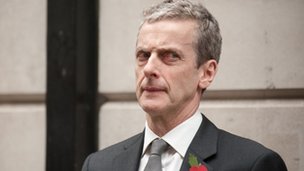 Capaldi won a Bafta for his role as spin-doctor Malcolm Tucker in The Thick Of It
Capaldi attended the Glasgow School of Art and it was while studying there that he landed his breakout role in the 1983 drama Local Hero directed by Bill Forsyth and starring Burt Lancaster.
Early roles in TV series Minder and Hollywood film Dangerous Liaisons led to a string of parts on shows such as Prime Suspect, the Crow Road and Neil Gaiman’s Neverwhere.
More recently he appeared in Skins, The Devil’s Whore, Torchwood: Children of Earth and BBC mini-series The Nativity.
Capaldi has also written several TV shows, including a documentary about 500 years of Scottish portrait painting broadcast on BBC Four and Cricklewood Greats – a spoof about the heyday of the British film industry.
He also wrote 1993 film Soft Top Hard Shoulder – which was nominated for a Scottish film Bafta – as well as writing and directing the 2001 gangster film, Strictly Sinatra.
Capaldi’s stage credits include Professor Marcus in The Ladykillers at the Liverpool Playhouse, which later transferred to the Gielgud Theatre in the West End.
A lifelong fan of Doctor Who, landing the role of the Time Lord is a dream come true for Capaldi.
He even wrote a letter to the Radio Times when he was a teenager in 1973, praising the magazine for its Doctor Who special celebrating the show’s 10th anniversary.
 Peter Capaldi’s letter to the Radio Times in 1973 praising its Doctor Who coverage
The Doctor Who casting comes after a busy year for the actor, who was seen on the big screen in zombie film World War Z and in BBC Two drama series The Hour, for which he was also Bafta nominated.
He is currently filming new BBC One drama series The Musketeers, in which he plays Cardinal Richelieu and which will air next year.
He will also appear in the forthcoming Julian Assange film The Fifth Estate as Guardian editor Alan Rusbridger and Disney’s Maleficent – a take on the Sleeping Beauty tale, starring Angelina Jolie.
For those who missed it live:

I’m not sure how I feel about this casting. On one hand it’s nice to see an established actor have the roll. It might bring a darker, more mature Doctor than before. On the other hand, I think he might be a touch too old. But, like I did with Matt Smith, I’m going to give him a chance to grow into the role and see what happens.
I don’t think it’s fair for any of us to pan his ability to be The Doctor without seeing how he does first. He may surprise us with a very complex, and intriguing portrayal as Smith did.
It will be interesting to see how things turn out, but I’ll tell you one thing: I’m betting the regeneration is during the 50th anniversary special. Why? Because there’s something River said the Clara and The Doctor. To enter your own time stream is fatal, that the winds of the vortex would tear you apart. Ok, so where’s the Doctor? Inside his own time stream. How will he get out if it’s fatal? Sounds like a regeneration to me.
Always pay attention to the words spoken during a Moffatt episode. He writes from the back to the front, so a lot of them foreshadow the climatic episode.
Peter Capaldi is the new doctor. Surprisingly they got it right. Interesting…
Peter Capaldi!
The Radio Times is reporting that Steven Moffat had quite a lot of trouble with the budget for the 50th Anniversary special. Here’s the quote: “It was unbelievably tough actually making the 50th…It was extraordinarily difficult mainly because we were trying to push the boat out and as ever we didn’t have enough money. We were making a feature-length Doctor Who on the schedule and budget for an hour. We’re doing it in 3D on the budget for 2D.”
This sort of using-Doctor-Who-as-a-testbed for shiny new special effects isn’t unprecedented; as mentioned in “The Writer’s Tale”, RTD recorded similar woes about the budget for “Planet of the Dead” and “The Waters of Mars”. He’d been asked to start making high-def telly but didn’t get commensurate funding for it (reading between the lines, it would appear that they pulled it off by cutting some FX shots and the miracles Julie Gardner could work negotiating with other BBC departments to obtain extra funds; unfortunately, Moffat doesn’t have a Julie Gardner). We’ve mentioned the show’s funding issues before (and, for that matter, that the BBC has decided to scrap future 3D productions on grounds of not being worth the trouble for money), but Moffat has been fairly discreet about the show’s budget up to now. Perhaps that’s something to do with why Moffat was so cagey on the length of the anniversary episode, if he wasn’t sure how much money he was going to have to work with (and BBC Worldwide, which is putting up part of the funds, just did their annual budget).
Commentary from the mind of the artist
A Story Begins
 Talia's World