I read a lot of posts on the writing forums about what to write, or how to write it, and it got me thinking. Is there truly a right way to write your book? And the answer has to be no! Here’s why:
Each person has their own style of writing (or what people like to call ‘voice’), which involves everything from sentence structure, complexity of vocabulary or thoughts. These are what separate lets’ say Stephen King from Clive Cussler or Hemingway from Faulkner.
I remember reading about Hemingway and Faulkner having their famous feud over various issues, with writing style being one of the biggest issues.
Faulkner made the comment:
He has never been known to use a word that might send a reader to the dictionary.
Now I take umbrage with that because I don’t care to send a reader to the dictionary either. Why do so when there’s plenty of words to get your point across that are simpler? Plus, in this age of dumbing down of people, a lot of readers may or may not even understand what you’re saying in the first place. So, why do so? You know what I mean? I, like King, think that writing is about enriching another persons life, not trying to show how much knowledge of Mirriam-Webster you have.
If you as a writer think that creating a novel is all about you and stroking your ego, then you’ve got the entire process of art wrong. Art is not done for the attention but for creative release and the enjoyment of others. Once again, I have to agree with this King quote:
“Writing isn’t about making money, getting famous, getting dates, getting laid, or making friends. In the end, it’s about enriching the lives of those who will read your work, and enriching your own life, as well. It’s about getting up, getting well, and getting over. Getting happy, okay? Getting happy.”
Getting yourself, and the reader happy, is the most important part of artistry-and that’s just how it is.
As for the Faulkner-Hemingway battle, I’m not through talking about that. Ernest had a shot to fire back over the comment about the dictionary:
Poor Faulkner. Does he really think big emotions come from big words? He thinks I don’t know the ten-dollar words. I know them all right. But there are older and simpler and better words, and those are the ones I use.
I’m personally on the side of Hemingway in this battle. I write simply and to the point. Long, complex sentences allow me more opportunity to screw something up or have to do a major editing to carry out to get it correct. With that said, I chose to use the simple words and simple sentences.
Sometimes the KISS formula is the best one.
Happy writing!
I was cruising the forums and someone was commenting about how a lot of beginning writers like to ask “what do you think about b’ab blah, blah?” What a ridiculous question to continually ask! The only one who knows if something is good or not is you the writer and any agent it’s sent off to.
What I really find silly are the ones who are worried about whether or not their writing is politically correct. Huh?? I have to agree with Stephen King’s quote:
“if you expect to succeed as a writer, rudeness should be the second-to-least of your concerns. The least of all should be polite society and what it expects. If you intend to write as truthfully as you can, your days as a member of polite society are numbered, anyway.”
Writing, like any art, has a tendency to shake society with its impact, so why worry about what others think? Unless you’re in a country that limits your ability to have free speech, write how you feel and be happy with it. Remember:
“Writing isn’t about making money, getting famous, getting dates, getting laid, or making friends. In the end, it’s about enriching the lives of those who will read your work, and enriching your own life, as well. It’s about getting up, getting well, and getting over. Getting happy, okay? Getting happy.”
Happy Writing.
This article is courtesy of slate.com.
I’m not privy to the results of their surveys, but it seems to be be 50-50 or 40-60 in favor of men in my local Barnes and Noble science fiction and fantasy section. However, with the said, mine might not the representative of them all.

It’s been well established that publishing is not a great place to be if you’re a woman.VIDA’s 2012 report on the proportion of men and women reviewed and reviewing at major magazines was just as bleak as usual. Geek culture can be equally unwelcoming to women, as recent events have shown. But what about the intersection of the two—science fiction and fantasy publishing?
The online magazine Strange Horizons has just published a study that applies VIDA’s methodology to sci-fi and fantasy publications, and it shows pretty much what you’d expect. Of 14 publications surveyed, only one reviewed books by women more than 50 percent of the time. (That was Cascadia Subduction Zone, which has the specific goal of “[treating] work by women as vital and central rather than marginal.”) Five of the publications devoted less than 25 percent of their coverage to books by women. The ratio of men to women among reviewers was similarly discouraging: Although three of the magazines employed more woman reviewers than men, seven had less than half as many women as men, and two publications had no female reviewers at all. (Admittedly, those last two publications had only four reviewers between them.)
These data are similar to what VIDA found in more mainstream publications, where only the literary magazine Tin House had more female contributors than male ones. (The New York Times Book Review deserves note for having 327 female reviewers to 400 male ones). Many of the reasons for and effects of those statistics hold across the genres as well. Male writers submit more short fiction, and are more willing to promote themselves. Most editors are men. The most popular and respected authors also tend to be male, as China Miéville, Neil Gaiman, and Brandon Sanderson can attest.
But considering fantasy and science fiction writing only as a microcosm of the larger publishing world misses the more complex dynamics that contribute to women’s position in the industry. I’ve so far been lumping together sci-fi and fantasy—and it’s true the line between them can be fuzzy. But there’s actually a considerable gap between how many women write novels classified as straight science fiction and how many write novels classified as fantasy or some combination of the two. Only about a quarter of science fiction novels are written by women; for fantasy and combination novels, it’s closer to half. This gap suggests that women writers are running up against the same division that causes so much trouble for us in other corners of the geek universe: the split between hardcore and casual fans.
As Game of Thrones has shown, mainstream audiences can embrace even the most labyrinthine epic fantasy. But that’s unlikely to be true for hard science fiction, much of which is heavily focused on scientific accuracy and plausibility. Hard sci-fi is not the only kind of science fiction, but the qualities it champions are profoundly important to a vocal subset of fans. Most people unfamiliar with science fiction, on the other hand, are not overly excited to read about the inner workings of a plasma engine. Even Miéville’s acclaimed novel Embassytown focuses on how the linguistic differences between races affect their relationship. As fascinating as the challenge of cross-species communication may be to some (myself included), it demands the kind of specialized knowledge you don’t need to appreciate, say, royal scheming and swordfights.
Just as women struggle to be taken seriously as scientists, they may struggle to be seen as writers of “real” science fiction. But for some, avoiding the bubble of hardcore fantasy and sci-fi has been a major boon. The three most successful fantasy authors of the past decade—J.K. Rowling, Suzanne Collins, and Stephenie Meyer—are women.* Similarly, the science fiction and fantasy writers embraced by mainstream literary culture are often women: Kelly Link, Susannah Clarke, and even Margaret Atwood have made their careers by straddling the line between genre and literary fiction.
Of course, as the VIDA numbers show, literary fiction can be an equally challenging environment for women. Whatever the reasons, whatever the genre, woman writers are still at a disadvantage.
*Correction, April 25, 2013: This post originally misspelled Stephenie Meyers’ first name.
This is from John Scalzi’s blog. The money is going to worthwhile cause.

A lot of people are asking if they should start their novel off with exposition and the answer is no! Do not take those first 5-6 precious paragraphs you need to catch a reader’s attention and waste them on useless narration. Do not put back story into them. In fact, you don’t have to write the back story in all at one time. Dribble it out! For example: I got an entire back story built for Talia, but I only let it out in drips and dribs over all of the novels with her. Plus, I’ll run a subplot that deals with something in her past that’s relevant to the current novel to help spread out the background. Keep in mind Stephen King’s quote on the subject:
“The most important things to remember about back story are that (a) everyone has a history and (b) most of it isn’t very interesting.”
So, don’t waste that valuable time on needless things.
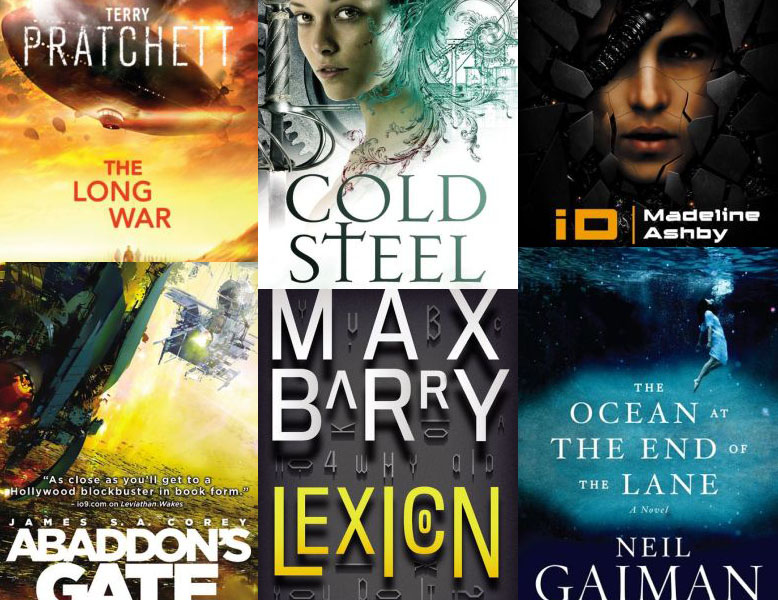
I’m surprised that four to five of the list are classics. Interesting.
Commentary from the mind of the artist
A Story Begins
 Talia's World