San Antonio’s Iron Rattler shut down after fatal Arlington ride

Per Beaumont enterprises website:


The new Iron Rattler features a 171-foot drop at a nearly vertical 81 degrees. It also has four overbanked turns (more than 90 degrees) and a top speed of 70 mph. Photo: John Davenport / San Antonio Express-News


The Iron Rattler at Six Flags Fiesta Texas in San Antonio remains closed as officials investigate what led to a fatal accident on another roller coaster at the company’s Arlington theme park.

Fiesta Texas spokeswoman Sydne Purvis said Monday that the decision to close the attraction was made late Friday after officials heard about the accident in Arlington. According to Dallas-area news outlets, the 52-year-old woman was thrown to her death from the Texas Giant at Six Flags over Texas about 7 p.m. Friday.

The Tarrant County Medical Examiner’s Office reportedly said that she died of “multiple traumatic injuries due to (a) fall from a roller coaster.” The Dallas Morning News said relatives identified her as Rosy Esparza, though the coroner’s office has identified her as Rosa Ayala-Gaona.

The Iron Rattler, which debuted in May, is “somewhat similar, although not identical” to the Texas Giant, Purvis said, describing them both as hybrid roller coasters made from a combination of wood and steel.

“They’re not identical in configuration, and in a number of other ways, the roller coasters are different,” Purvis said.

It wasn’t clear early Monday how long the Iron Rattler would remain shuttered. Purvis said the decision was made as a precaution. Six Flags over Texas officials told the Fort Worth Star-Telegram that the Texas Giant will remain closed until the end of an in-house investigation into the woman’s death.

The Iron Rattler is a revamped version of the theme park’s original Rattler, a 20-year Fiesta Texas landmark that was retired in August 2012. The Iron Rattler runs on new steel tracks and rails added to its iconic predecessor’s wooden structure.

The redesign increased the original coaster’s drop from 124 feet to 171 feet, upgraded the drop from about 61 degrees to a much steeper 81 degrees and added 5 mph to the ride’s top speed. The old Rattler’s top speed was 65 mph. The Iron Rattler’s is 70 mph.

On June 12, 2007, Hailey Kuhn, 14, fell off a rollercoaster platform and was paralyzed while waiting in line to ride the Poltergeist at Fiesta Texas.

An Express-News investigation found that Texas ride owners told state officials that more than 1,800 people were injured on or near amusement rides from 2000 to 2008 — an average of about 230 per year. Most victims suffered only scrapes and bruises, and the official tally of injuries has declined over the years. But there have been painful mishaps — at least 120 people broke bones; nearly 60 people had teeth chipped or knocked out; and four people suffered amputations.

Prices Fuel Outrage in Brazil, Home of the $30 Cheese Pizza

This is here right now too. If you factor in the ‘volatile food and energy markets’ (which is where WE PAY THE MOST) inflation in the USA is running 7%+. Throughout the globe, economies are crashing because they’re taking money from those who are making income and giving it to those who won’t work (those who can’t work deserve to get our help). What that does is drain funds from the economy by taking away disposable income for those who are working. Is it any surprise then that the economies are stagnant or in recession/depression? It doesn’t take much brains to see that these quasi-socialist, socialist and/or Marxist systems just don’t work. Why? Because eventually you run out of money!

I sit back and watch the calls for us to ‘take the money from the 1% they’ve stolen.’ Well, that’s all good, but even if we took 100% of their money, it’d fund the government for less than a week. So, what then? Now all the money from the ‘rich’ has been taken, so who gets the chopping block next? The upper middle class, then the middle of the middle class and then the lower middle class. Then 401k’s will be nationalized (an Idea Obama has floated before) and that money will be taken from those who’ve worked their ass off. Soon, you’re down to the poor, who have no money, and that’s when the system collapses under it’s on weight. It’s happening in Greece and many other countries and will happen here-it’s a certainty…you can take that to the bank.


Per the NY Times

By 
Published: July 22, 2013

SÃO PAULO, Brazil — Shoppers here with a notion of what items cost abroad need to brace themselves when buying a Samsung Galaxy S4 phone: the same model that costs $615 in the United States is nearly double that in Brazil. An even bigger shock awaits parents needing a crib: the cheapest one at Tok & Stok costs over $440, more than six times the price of a similarly made item at Ikea in the United States.

Multimedia

For Brazilians seething with resentment over wasteful spending by the country’s political elite, the high prices they must pay for just about everything — a large cheese pizza can cost almost $30 — only fuel their ire.

“People get angry because we know there are ways to get things cheaper; we see it elsewhere, so we know there must be something wrong here,” said Luana Medeiros, 28, who works in the Education Ministry.

Brazil’s street protests grew out of a popular campaign against bus fare increases. Residents of São Paulo and Rio de Janeiro spend a much larger share of their salaries to ride the bus than residents of New York or Paris. Yet the price of transportation is just one example of the struggles that many Brazilians face in making ends meet, economists say.

Renting an apartment in coveted areas of Rio has become more expensive than in Oslo, the capital of oil-rich Norway. Before the protests, soaring prices for basic foods like tomatoes prompted parodies of President Dilma Rousseff and her economic advisers.

Inflation stands at about 6.4 percent, with many in the middle class complaining that they are bearing the brunt of price increases. Limiting the authorities’ maneuvering room, the popular indignation is festering at a time when huge stimulus projects are failing to lift the economy from a slowdown, raising the specter of stagflation in Latin America’s largest economy.

“Brazil is on the verge of recession now that the commodities boom is over,” said Luciano Sobral, an economist and a partner in a São Paulo asset management firm who maintains an irreverent economics blog under the name the Drunkeynesian. “This is making it impossible to ignore the high prices which plague Brazilians, especially those who cannot easily afford to travel abroad for buying sprees where things are cheaper.”

Brazil’s sky-high costs can be attributed to an array of factors, including transportation bottlenecks that make it expensive to get products to consumers, protectionist policies that shield Brazilian manufacturers from competition and a legacy of consumers somewhat inured to relatively high inflation, which remains far below the 2,477 percent reached in 1993, before a drastic restructuring of the economy.

But economists say much of the blame for the stunningly high prices can be placed on a dysfunctional tax system that prioritizes consumption taxes, which are relatively easy to collect, over income taxes.

Alexandre Versignassi, a writer who specializes in deciphering Brazil’s tax code, said companies were grappling with 88 federal, state and municipal taxes, a number of which are charged directly to consumers. Keeping accountants on their toes, the Brazilian authorities issue an estimated 46 new tax rules every day, he said.

Making matters worse for many poor and middle-class Brazilians, loopholes enable the rich to avoid taxation on much of their income; wealthy investors, for instance, can avoid taxes on dividend income, and partners in private companies are taxed at a much lower rate than many regular employees.

The result is that many products made in Brazil, like automobiles, cost much more here than in the far-flung countries that import them. One example is the Gol, a subcompact car produced by Volkswagen at a factory in the São Paulo metropolitan area. A four-door Gol with air-conditioning sells for about $16,100 here, including taxes. In Mexico, the equivalent model, made in Brazil but sold to Mexicans as the Nuevo Gol, costs thousands of dollars less.

The ability of many Brazilians to afford such cars reflects positive economic changes over the past decade, like the rise of millions of people from grinding poverty and a decline in unemployment, which is now at historically low levels. Salaries climbed during that time, with per-capita income now about $11,630, as measured by the World Bank, compared with $6,990 in neighboring Colombia. But Brazil finds itself far below developed nations like Canada, where the per-capita income is $50,970.

As a result, a resident of São Paulo, Brazil’s financial capital, has to work an average of 106 hours to buy an iPhone, while someone in Brussels labors 54 hours to buy the same product, according to a global study of wages by the investment bank UBS. To buy a Big Mac, a resident here has to work 39 minutes, compared with 11 minutes for a resident of Chicago.

Stroll into any international airport in Brazil, and such imbalances are vividly on display, with thousands of residents packing into flights each day for shopping trips to countries where goods are substantially cheaper.

Even though the Brazilian currency, the real, has weakened against the dollar this year (it currently stands at about 2.20 to the dollar), Brazilians spent $2.2 billion abroad in May, the highest amount on record for the month since the central bank began tracking such data in 1969.

Eyeing this market, some travel agents have begun tailoring trips to Miami for clients eager to buy baby products like digital monitors, strollers, pacifiers, even Pampers wipes, which in Brazil cost almost three times as much as in the United States.

Seeking to prevent such shopping binges from getting out of control, the federal police screen travelers upon arrival, picking out people whose luggage appears to bulge with too many items. If it can be proved that Brazilians spent over a certain limit abroad, they are immediately forced to pay taxes on their purchases.

Such screening catches foreigners, too. In May, the police at São Paulo’s international airport arrested two American Airlines flight attendants, both American citizens, on smuggling charges after they were found going through customs carrying a total of 14 smartphones, 4 tablet computers, 3 luxury watches and several video games. The smartphones were hidden in their underwear, the police said, and were intended to be sold on the black market.

Before the protests began, Brazil’s government had begun trying to combat price increases. The central bank raised interest rates after an uproar over food prices this year contributed to inflation fears. The authorities removed some taxes on some products, like cars. Even so, inflation remains high while the economy remains sluggish, leaving many Brazilians fuming about the high taxes embedded in the price of products they buy.

A new federal law requiring retailers to detail on receipts how much tax customers are being charged has fed some of this anger. Fernando Bergamini, 38, a graphic designer, was stunned after spending $92 one recent day on groceries like tomatoes, beans and bananas, only to glance at his receipt and discover that $25 of that was in taxes.

“It is shocking given the services we receive for giving the government our money,” Mr. Bergamini said. “Seeing it like this on a piece of paper makes me feel indignant.”

Lucy Jordan contributed reporting from Brasília, Taylor Barnes from Rio de Janeiro, and Paula Ramon from São Paulo.


The Bankruptcy of Detroit

I’ve been following that sad state of affairs with great interest. Why? Because it’s the ultimate fate of our country due to the debt we have-but that’s neither here nor there. What bothered me were statements made on the radio today.

This afternoon I had nothing to do so I was on my way home and for the first time in a while, I turned the radio on. A nationally syndicated blow hard was on and he spoke about the Detroit deal. The reasons for the bankruptcy in his mind were ‘the unions’ and ‘liberalism.’ While I do think making people dependent on the system, and then taking money from others to pay to the dependent ones, is morally wrong, that’s not the only reason for the destruction of Mo-town.

Nor were the unions totally to blame either. Big Management wants to make sure they get every damn dime they can and that’s how it is. And if we didn’t have unions, then we’d all be slaves to the company. The 40 hr work week, vacations, labor laws and benefits all came about in the USA due to the unions, so they’ve done many things to help out the worker.

With that said, here’s the rub. Both parties helped cripple the auto industry. Do you really think it costs 50k to build a 4×4 F-150? Seriously, that’s so overpriced it isn’t funny. Why? Because the company is going to make sure management (specifically the upper echelon) gets their outrageous pay and then uses the ‘good old boy’ network to make sure their buddies do too. All these CEO’s are on other company’s Board of Directors so it becomes ‘you scratch my back, I’ll scratch yours.’ “You give me thirty million here and I’ll vote to give it to you at your company.” What a fucking racket. However, do Union workers need $40 per hour to build cars? No, but despite all that is said on the right, the figures that the CEO’s, and the other members of upper management, are getting is causing far more harm than the unions. So, look at the figures of their pay and think about whenever they say the ‘unions are killing us on labor cost.’ I’ll bet you 20 bucks they’re mad because it’d cut into their big ass paychecks, which is why they’re angry.

http://money.cnn.com/magazines/fortune/fortune500/2012/ceo-pay-ratios/

Now look at those figures and tell me it’s the unions fault! I’m sorry, talk radio, but the 1%, both in business and politics/government, are getting richer off our backs and we’re not seeing a damn dime of it really. Looks like it’s time for a union renaissance.

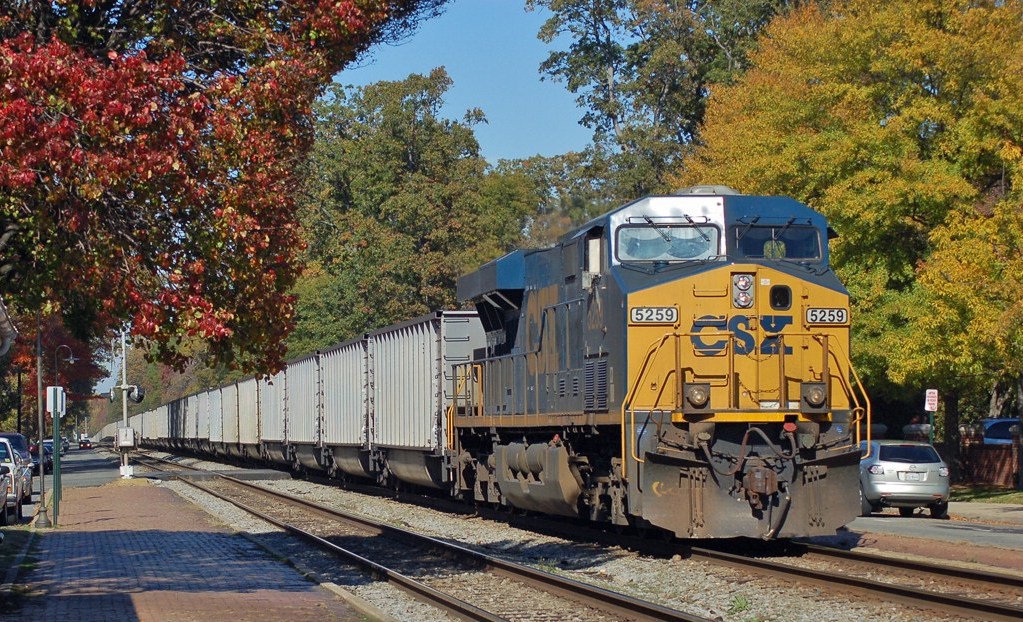
Train Physics and Video

csxt5259U783pusher1


In this video we have a Canadian Pacific (CP) container train leaving the yard after a crew change. Note how he gradually increases the power. You can tell when he grabs each ‘notch’ (which means the slot on the control stand) as they get up to speed. I can hear the question: “Why didn’t he just give it full power and take off?” Well, here’s why:

The standard drawbar on a car is rated for 350-390k pounds of force, so if the engineer took off too hard, then he could exceed that and pull the train apart. That’s not good. If it’s a broken knuckle, that can be replaced fairly easily. If a drawbar is pulled, then that can require the car department to come fix it-and they could be in that yard or at another one several hours away. Either way, it’ll tie of the RR, get the Trainsmaster’s upset an truly anger the Dispatchers because it ruins the flow.

http://www.youtube.com/watch?v=_k_T1BDLBNM

Seismic ‘scream’ portends violent volcanic eruption

la-sci-sn-seismic-scream-portends-violent-volc-001


By Monte MorinJuly 15, 2013, 5:04 p.m.

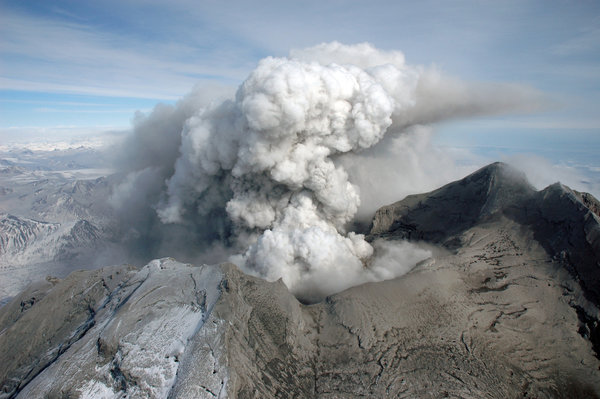
It began as series of small shuddering earthquakes beneath Alaska’s Mt. Redoubt that gradually coalesced into a high-frequency “scream,” according to seismologists.

While scientists could only guess as to what triggered the vibrations, there was no question about what happened next: The seismic scream was followed by 30 seconds of silence, and then a series of volcanic eruptions — 20 over a two-week period — that launched an enormous plume of ash resembling a mushroom cloud.

In a study published recently in Nature Geoscience, researchers examined data from the 2009 eruption and concluded that the sustained vibrations were caused by numerous so-called stick-slip movements on faults more than a mile beneath the volcano.

While researchers said it was beyond the scope of their study to determine the cause of the quake, they theorized that it was the result of pressure building in blocked magma conduits underground.

“Blockage of conduit flow increases magma pressure, driving increasingly rapid deformation until the obstruction is breached and an explosion commences,” wrote lead study author Ksenia Dmitrieva, a graduate student in the department of geophysics at Stanford University, and colleagues.

High-frequency harmonic tremors have been recorded before other volcanic eruptions, as well as in the collision of icebergs. Usually, these tremors cannot be heard by people. In the case of the Redoubt eruption, however, the shaking was just barely audible as a hum, according to study authors.

“Although this is a rare and extreme example, if you ever happen to be near an active volcano and feel the ground humming, you might want to take cover,” wrote study co-author Alicia Hotovec-Ellis, a graduate student in the Department of Earth and Space Sciences at the University of Washington, in Seattle.

Click here to read more and listen to a recording of the scream.

Villagers flee as Indonesian volcano spews ash

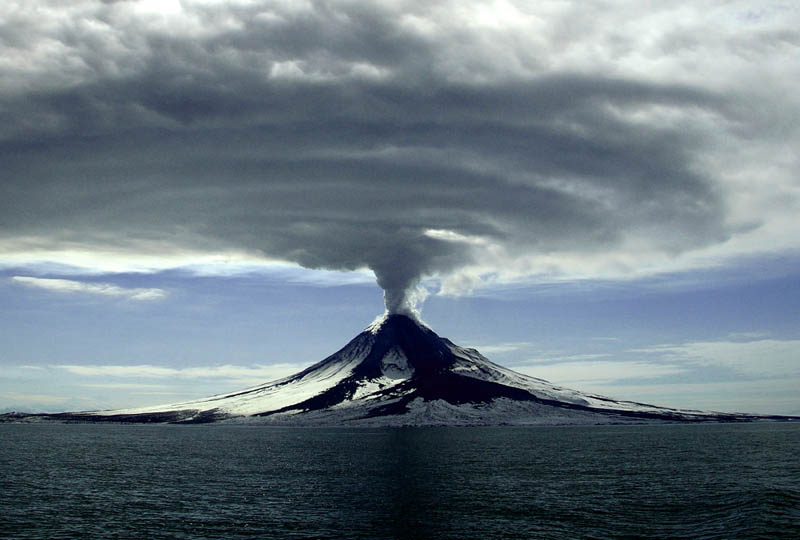
mt-augustine-alaska-2006-volcanic-eruption


A resident of Cangkringan district in Indonesia's Central Java province wears mask to protect himself against volcanic ash from Mount Merapi (background) after spewing volcanic ash.Photo / AFP

A resident of Cangkringan district in Indonesia’s Central Java province wears mask to protect himself against volcanic ash from Mount Merapi (background) after spewing volcanic ash.Photo / AFP

Indonesia’s most volatile volcano spewed smoke and ash Monday, forcing hundreds of people to flee their villages along its slopes, a disaster official said.

Mount Merapi on the main island of Java rumbled as heavy rain fell around its cloud-covered crater, said Sutopo Purwo Nugroho, disaster mitigation agency spokesman.

The volcano unleashed a column of dark red volcanic material 1,000 meters into the air, and the ash made the rain thick and muddy in several villages as terrified residents fled to safety, he said.

The sound was heard 30 kilometers away, but an eruption did not occur and the volcano’s alert level was not raised, Nugroho said.

The 2,968-meter mountain is the most active of 500 Indonesian volcanoes. Its last major eruption in 2010 killed 347 people.

Indonesia, an archipelago of 240 million people, is prone to earthquakes and volcanic activity because it sits along the Pacific “Ring of Fire,” a horseshoe-shaped series of fault lines.

– AP


http://www.nzherald.co.nz/world/news/article.cfm?c_id=2&objectid=10901602

Ender’s Game Producer Bob Orci Talks Casting Harrison Ford and Believing In UFOs at Comic-Con 2013

from the Huffington post:


Shira Lazar

Co-founder, WhatsTrending.com


Ender’s Game producer Bob Orci chats with What’s Trending at Nerd HQ at San Diego Comic-Con 2013 about the buzz surrounding his upcoming sci-fi film, based on Orson Scott Card’s classic novel.

“Audiences have seen a lot of everything,” Orci says. “They’re pretty savvy. They’re pretty smart and this book was around for a long time, trying to get made into a movie. I think some studios were afraid that it was this young protagonist but it’s adult themes. It’s complicated. It’s challenging. It’s not the usual structure.” But he says that Comic-Con is the perfect place to market the film because Comic-Con celebrates fandom.

In terms of translating the novel for a modern audience, Orci says that the work was done for him in the book. “Interestingly enough, the book itself was very prescient in ’84,” he says. “It predicted war at a distance. It predicted blogging and elements of the Internet, devices you can touch. So we didn’t have to do a lot of updating.”

Orci reveals that while a lot of the cast emerged from just being fans of the book, choosing Harrison Ford was an exciting process. “Well, you think you’re deciding on him, but really he’s deciding on you,” Orci says. “What he said when he read the script actually was that he’s offered a lot of sci-fi. He’s read a lot of sci-fi. And that this was one of the rare ones where he felt that actually not only was it a spectacle but it also had something to say and had a lot of emotion and that’s why he did it.”

He also shares a funny moment in which he asked Ford if he would ever like to direct, and he quoted Bob Hoskins by replaying, “No. Directing is like getting pecked to death by a thousand penguins.”

Orci also shares some information about filming the movie with the young and talented lead, Asa Butterfield. “We shot it in sequence, funnily enough. So you actually do see Asa grow. He grew two inches during the filming of this movie.” He adds, “His experience in the movie sort of mirrors the character’s experience of […] eventually becoming this competent leader and simultanously in front of the camera becoming a more confident actor.”

For more exclusives from San Diego Comic-Con 2013, subscribe to What’s Trending!