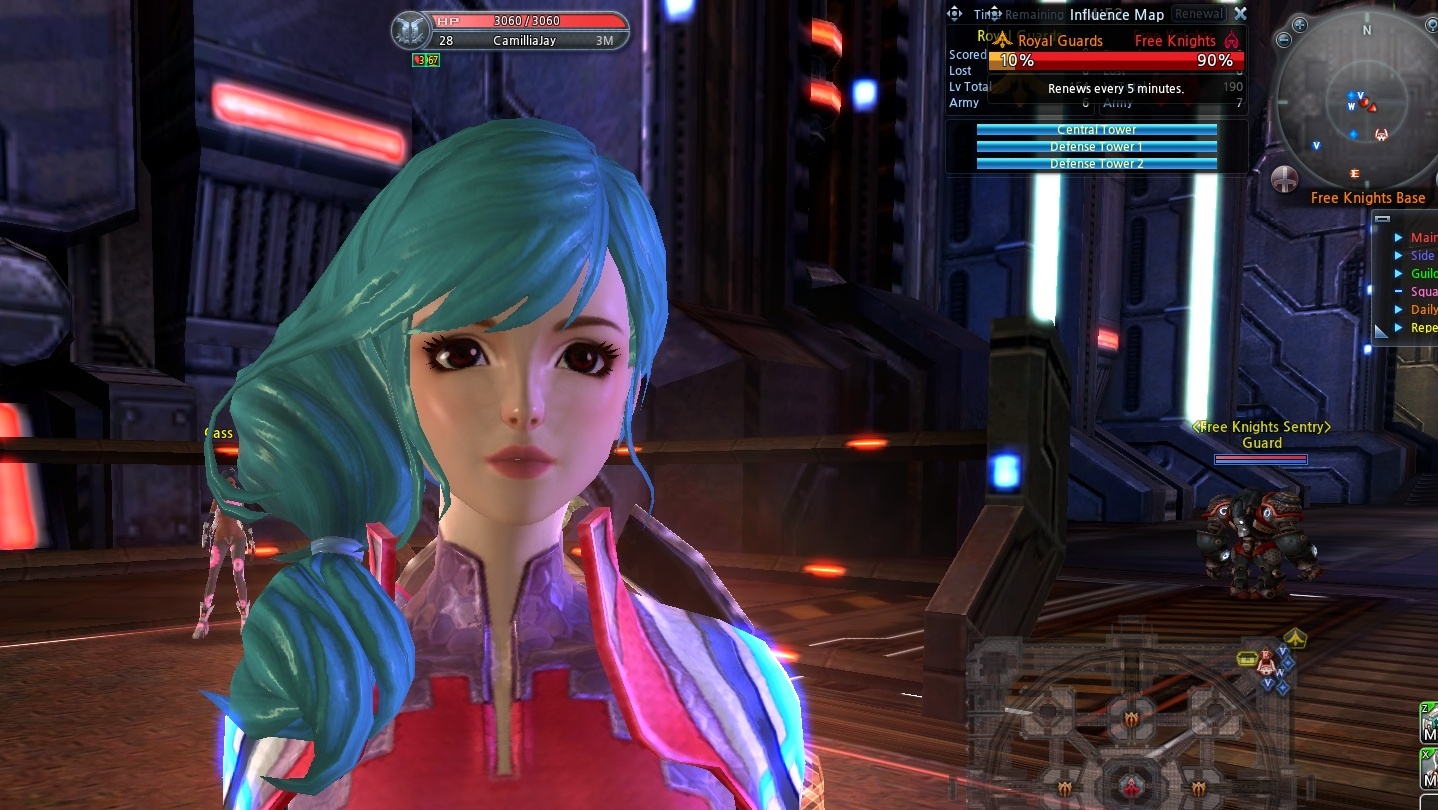
The Medic I’ve created in Scarlet Blade is named Dannae, and she’s the closest I’ve come to making something that looks like her in my mind’s eye. So here’s three different shots. Be sure to knock the side of her bust in half, please. Scarlet Blade tends to like giving it’s characters massive breasts. I think the Koreans might be breast fixated…
Tag Archives: science fiction
Writing on the Third Talia Novel
In many ways feels like it’s taking forever. I’ve been putting time into the Micki novel and I feel like I’ve lost the ‘feel’ I normally have with a novel, so I’m debating whether or not to stop writing on it for the time being. I don’t want to abandon it because I’m onto the fifth chapter, but I can’t seem to make the connection at this point.
Maybe it’s just me and I’m worrying too much. Sometimes, as King would say, we writers try to shy away from what’s hard instead of pushing through. I fear this is what I’m doing. Maybe I just need to keep working away.
A Day In The Life Of A Writer
Today I’ll share the glorious world of a fiction writer. On the days that I don’t have to worry about anything but writing, this is how it goes.
11AM is when I’ll wake up and brew of cup of Starbucks’ Blonde Willow Blend and I sit down to play Scarlet Blade. This will take up a couple hours as I let the cobwebs clear from my wind. After that it’s moving on to a shower. Once finished, I then start to work on writing projects.
As I mentioned before, I finished the first Talia novel and have now moved onto a new project. However, with that said, I learned a valuable lesson. A couple days ago there was a thread going over at the Writing Forums that was enough to make me shake my head. ‘How Many Words Do You Write In A Day.’ Listening to the figures, it was unsurprising to see how merde comes out of a lot of amateur writers. I’ve learned that things are simple:
If you slow down, you stand a better chance of writing good stuff.
Why? Because it gives you an opportunity to sit back and construct your sentences, paragraphs and chapters better. You, as the writer, can pay close attention of every word you put onto paper that way, which will, in turn, cut down on the sheer amount of editing necessary when finished with the rough draft.
I learned this as I ended up hard copy editing this novel two times. After practicing since ’08, this shouldn’t be something I need to do, so I plan to help prevent that by slowing down.
If there is any piece of advice I can give is to do what it takes to make sure you pay attention to every word, sentence, paragraph and chapter.
Sometimes the turtle gets the prize.
Ok, once I’ve written between 1-1.5k words, I call it a day. Yes, there are times that I feel I could go on forever, but is the quality there?
Now it’s dinner time, which is the one meal I really eat each day. If I have 2 it’s normally a weird move…and three is very rare. So, I’ll have anything ranging from pizza to Chinese and then settle down for the evening.
Reality television, outside of Wipeout, has no appeal to me, so I’ll crank up the BBC and see if any good dramas are on. If not, I’ll plug the ear buds into the laptop and watch anime for a couple hours.
I end the day playing Scarlet Blade until bedtime. There you have it, the day in the life of a writer. Glorious isn’t it?

Finished With First Talia Novel

And I have to say I’m pleased with myself. Normally when writing I’ll go over and over on a project and never finish. Not this one. For better or for worse, it’s a completed project.
Onto submitting.
Writing a novel is a lot like running a marathon. Sprinting doesn’t win the day, it’s slow and easy that does. Cranking out 4-6k of words a day may sound good on paper, but is the writing worth a damn?
I’ve gotten to the point that I’m writing somewhere between 1.5 to perhaps 2k a day and taking my time. This allows for getting paragraphs right the first time then having to rewrite things over and over. I don’t know about you guys, but I get brain fried from working over and over on the same project. Right now, you couldn’t get me to touch this manuscript unless someone threw a bunch of money at me. Why? Because I’m burned out of this story. I want to move on and that’s what I’m doing.
My current projects are: Third Talia novel, a first Novel around a character named Micki and a serialized Talia novel for my blog. Those are enough to keep my busy for a while, and I still have the second Talia novel to edit!! Honestly, I’m too tired from editing the first one to take that one on, so I’m hitting the creative side instead.
Now that it’s done, let’s cross fingers and hope someone picks it up. If not, I might put it out as an e-book and try to sell the second one. Perhaps, if that one is picked up and sells, I might be able to sell the rights to a publisher and the first one could end up in the market too.
Well, that’s getting ahead of myself. Here’s to hoping things go well.
Serialized Novel
I’m currently working on a pair of new projects, so it’ll be a slow dribbling process. What I am going to do is take both chapters down and edit them and get a polished version up there. Each one from now on will be polished, which means it’ll take a bit between chapters being posted so bear with me.
Otherwise, I hope everyone enjoys it.
8-1-2013 Daily Top Ten Bestselling Science Fiction Adventure Novels
‘Ender’s Game’ finds controversy, fans at Comic Con
‘Ender’s Game’ and Spider-Man: Pop Culture’s Big Gay Panic
by Mark Harris on Jul 19, 2013 at 9:55AM
Image Credit: Jaimie Trueblood
Most artists and writers instinctively dislike the idea of cultural boycotts, and for good reason. The scales should always tip toward freedom of expression — even disagreeable expression — and when we fight over pop culture, our arguments should stem from knowledge rather than from a flat refusal to engage with questionable material. Besides, most cultural boycotts are strategically ineffective; it’s hard to tally the number of people who don’t see a movie or watch a TV show, and impossible to determine when staying away constitutes a statement and when it merely indicates lack of interest.
As a manifestation of anger or disgust, boycotts are extreme and, appropriately, rare. So it’s noteworthy that talk of an organized protest against the sci-fi drama Ender’s Game, which opens Nov. 1, has heated up enough to provoke responses from both Orson Scott Card, the author of the novel on which it’s based, and the movie’s distributor. Card is an outspoken opponent of marriage equality whose decades-long history of antigay public commentary is well documented; now that he has a movie to sell, he is saying that in the wake of the recent Supreme Court decision overturning a portion of the Defense of Marriage Act, the issue is “moot.”On July 8, he gave a statement to EW in which he urged gay rights supporters to show “tolerance toward those who disagreed with them when the issue was still in dispute.”
It’s hard to know where to begin to dismantle the smugness and intellectual dishonesty in Card’s words. His assertion that gay rights are now “moot” in a country in which 37 states still consider my marriage unworthy of recognition is weak enough, but I’d rather move on to his self-serving appropriation of “tolerance.” No group of people is required to tolerate those who would oppress them, but beyond that, Card is using calm and temperate language to disguise the extremity of his position. He’s not simply against marriage equality; as recently as 2008, he publicly called for straight married Americans to unite in an effort to “destroy” their “mortal enemy,” by which he meant a revolutionary overthrow of any U.S. government led by “dictator-judges” who support same-sex marriage. He’s an off-the-spectrum hatemonger cloaking himself as a voice of principled opposition, and he richly deserves to be shunned.
GET MORE EW: Subscribe to the magazine for only 33¢ an issue!
But should Card’s extremism lead moviegoers to boycott Ender’s Game, which, after all, has nothing to do with gay rights? As gay screenwriter Dustin Lance Black (Milk), who opposes a boycott, has noted, the film was made by a gay-friendly filmmaking team working for a company, Lionsgate, that has now publicly rejected his views. I can answer only for myself: I won’t pay to see the movie. I can’t get past the idea that my purchase of a ticket might put even an extra penny in the pocket of a man who thinks I should be treated as less than human; a hit film will increase sales of his books, and I want no part of it. Is that a boycott? It’s a personal choice, and a boycott is really nothing more than a network of people whose convictions lead them to the same personal choice. I understand the case that the art should be separated from the artist, and I have seen plenty of art by reprehensible people. But everybody gets to decide for themselves where they draw the line. (Why didn’t I draw it at, say, Roman Polanski? Probably because he doesn’t want me demonized, but I’m aware that that’s a weak and self-interested argument.) In any case, I don’t believe that people who choose to see Ender’s Game are enemies of gay rights, but if you’re on the fence, here’s a compromise: Write a check for the cost of a movie ticket to an organization that opposes Card’s views, and then go enjoy the film with a clear conscience.
Now back to “tolerance.” Two days after Card made his statement, Andrew Garfield, the star of the forthcomingAmazing Spider-Man 2, cheekily asked EW writer Sara Vilkomerson what would be so bad about Peter Parker having a boyfriend. “Why can’t we discover that Peter is exploring his sexuality?” he wondered, slyly adding that he was “kind of joking, but kind of not joking” about Mary Jane, or M.J., being “a dude.” Garfield deserves great credit not just for open-mindedness but for being the first actor in years to say something interesting about playing a superhero; most of them just talk very soberly about the immense responsibility they have been handed and sound like they’re getting bar mitzvahed. But the way the comment board lit up, you’d have thought he stopped in the middle of the interview to roll a joint made out of a Dead Sea Scroll. The (printable) arguments against his suggestion were, in no particular order: (1) Andrew Garfield must have an “agenda.” (2) Spider-Man is not a “social experiment.” (3) “Don’t try to change a classic just to prove a point.” (4) Spider-Man isn’t gay! Go get your own superhero! (5) You’re gay. (6) No, you’re gay. (7) Why can’t there be an Aquaman movie? (You gotta love comment boards.)
Since comic-book movies are probably going to dominate screens for at least the next half decade, can we at least agree to lighten up a little bit? Moviegoers can be remarkably flexible when they feel like it. In the past decade, Spider-Man has been played by two different actors. We accept him as being in high school even though Garfield turns 30 next month. There has been an evil Spidey. Replacement Spideys. A Latino/African-American Spidey in a 2011 comic-book series. Alternate-universe Spideys. A singing Spidey in a lavish Broadway musical. Spidey has died and come back to life. However, the second anyone questions the sexuality of a boy who likes to dress in spandex and swing through lower Manhattan, suddenly you have a chorus of fanboys saying, “But that’s not realistic!”
I don’t think Garfield is suggesting that Spider-Man is gay; he’s merely pointing out that in a field as open to speculative imagination as comic books, the assumption of heterosexuality is more automatic than it should be. The sharp and even hostile reaction to his gentle provocation only reinforces the fact that it was a point worth making. What was that about gay people learning tolerance, Mr. Card? Thanks for the unsolicited advice. You first.
Top Ten Science Fiction Movies of All Time
According to the UK Daily Guardian