Box Office: ‘Despicable’ Repeats and Sandler Soars, but No ‘Pacific Rim’ Surge

Things are not looking good.

The Wrap

By Todd Cunningham | The Wrap – 10 hours ago
 

'Pacific Rim' Third as 'Despicable Me 2' Edges 'Grown Ups 2' at Box Office


“Despicable Me 2” edged the Adam Sandler comedy “Grown Ups 2” at the domestic box office this weekend, while the surge some predicted for Guillermo del Toro’s “Pacific Rim” never quite materialized — making it the latest big-budget beast to come crashing down this summer.

A big Saturday turnout lifted the animated kids film from Universal and Illumination Entertainment to an estimated $44.7 million in its second week. It passed the $200 million mark Saturday at the domestic box office, just the fourth animated film to do it in that timeframe, and its global haul is now nearly $475 million.

“Grown Ups 2” had led the pack after a terrific $16.5 million opening day Friday, but the family crowd began turning the tide for the minions of “Despicable Me 2” on Saturday — and Sony’s PG-13-rated comedy wound up at $42.5 million. That’s better than the 2010 debut’s $40 million open, and that film went on to take in $270 million worldwide, best-ever for a Sandler movie.

Also read: Bombs Away: Hollywood Braces for Historic 4 Straight Weeks of Megaflops

Del Toro’s giant robots-vs.-monsters 3D epic was running second after Friday but lost some steam and finished the weekend with an estimated $38.3 million. That just under where the analysts had the $180 million tentpole movie landing, after weeks of soft pre-release tracking.

Legendary Entertainment and Warner Bros. had hoped the film’s “A-” CinemaScore and strong reviews — it was at 72 percent positive on Rotten Tomatoes — would drive word-of-mouth so that it could play beyond its core audience of young boys and Del Toro fans. But Saturday’s haul was about 13 percent down from Friday’s, which were swelled by $3.6 million.

The fanboys turned out in force, particularly for 3D showings and at Imax, which accounted for a whopping 19 percent of the grosses. The crowd was predictably young (67 percent under 35) and male 61 percent).

“Three weeks ago we were looking at $25 million-$30 million, so we’ve come a long way and this gives us something to build on,” said Warner Bros. head of distribution Dan Fellman. “We have great reviews, a strong CinemaScore and strong word of mouth. Our job now is to take that and expand it beyond that fanboy base over the next weeks.”

Warner Bros is counting on a big international performance from “Pacific Rim,” which should get a boost from Del Toro’s significant international following. It’s off to a decent start with $53 million in 38 markets this weekend.

 “Pacific Rim” is the third box-office misfire for a big-budget tentpole in as many weeks, coming on the heels of last weekend’s disappointing debut of Disney’s $225 million “Lone Ranger” and Sony’s “White House Down” the week before that.

A big part of that is the intense competition this summer, which is filled with $100 million-plus would-be blockbusters. The overall box office remains healthy — summer is running about 13 percent ahead of 2012 — and the weekend’s numbers continued that trend. Overall business was up nearly 30 percent over last year’s comparable weekend, when “Ice Age: Continental Drift” opened to $46 million.

Critics loathed “Grown Ups 2” – it has a 7 percent positive rating on Rotten Tomatoes – but


moviegoers gave it a “B” CinemaScore and the solid debut underscored the disconnect between reviewers and Sandler fans.

The audiences were young, with 54% under 25, and surprisingly female at 53 percent, suggesting it was drawing families.

The strong showing — particularly since it was competing with the R-rated Melissa McCarthy-Sandra Bullock comedy “The Heat” — signals a box-office turnaround for Sandler.

He voiced Dracula in Sony’s surprising animated hit “Hotel Transylvania,” but his last two live-action efforts – “Jack and Jill” and “That’s My Boy” – have disappointed. The latter film was R-rated and a bid by Sandler to broaden his youthful base, but it came up short. Reteamed with Kevin James, Chris Rock and David Spade, the PG-13-rated sequel — made for $80 million — was right in his wheelhouse.

                                          Weekend         Total
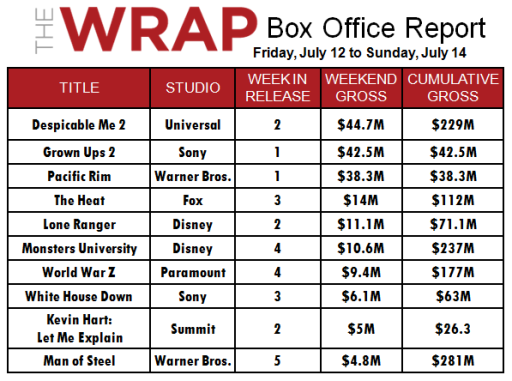
1. Despicable Me 2              $44,754,000    $229,237,000
2. Grown Ups 2                    $42,500,000    $42,500,000
3. Pacific Rim                      $38,300,000    $38,300,000
4. The Heat                          $14,000,000    $112,363,000
5. The Lone Ranger              $11,140,000    $71,101,000
6. Monsters University           $10,621,000    $237,760,000
7. World War Z                     $9,430,000    $177,087,000
8. White House Down            $6,150,000    $62,963,000
9. Kevin Hart: Let Me Explain $5,000,000    $26,378,000
10.Man of Steel                     $4,825,000    $280,995,000

Why ‘Pacific Rim’ is a good movie for geek girls

http://popwatch.ew.com/2013/07/13/pacific-rim-good-geek-girls/


Per Entertainment Weekly:

PACIFIC-RIM-HUNNAM


by  on Jul 13, 2013 at 4:59PM  @maricelag21


There isn’t much entertainment out there for ladies of the geek persuasion — or to be more accurate, geek ladies and geek gentlemen attracted to other gentlemen. Well, at least there isn’t much marketed directly to us. But we all know the dirty little secret of being a geek lady in a predominately geek man’s world — there are a lot of hot guys in sci-fi movies. Pacific Rim, which opened yesterday, is no exception. SOME SPOILERS AHEAD!

Pacific Rim is in no way a perfect movie. It’s plagued with corny dialogue, underdeveloped characters, and a predictable, anticlimactic ending. And like most sci-fi movies, it doesn’t pass the Bechdel test. The Bechdel test, named after cartoonist Alison Bechdel, requires a movie to include at least two named female characters who talk to each other about something besides a man. There are two named women in Pacific Rim — Mako Mori (Rinko Kikuchi) and Lt. Sasha Kaidanovsky (Heather Doerksen). However, Doerksen has a small role, says a few lines (most of which are directed toward her husband and copilot), and dies in the middle of the movie. Kikuchi’s Mako is a central character with a dynamic story arc though she’s less active than her male counterparts. Unlike many ladies in sci-fi, she is not objectified or criticized solely on the basis of her gender — a conscious decision made by director Guillermo del Toro.

So what is there for a geeky woman to enjoy in Pacific Rim? Well, there’s plenty of male eye candy. Charlie Hunnam plays Raleigh Becket, who returns from a five-year hiatus to help fight alien kaijus. Without his flesh-toned beard and biker hair from Sons of Anarchy, Hunnam can’t hide his striking features from the audience — or his costars. Mako practically screams “I’m the audience’s surrogate!” as she looks through a peephole at Raleigh’s shirtless torso, marked with tattoo-like scars from his previous battles. The multiple voyeuristic peephole shots recalls Psycho, but the fact that a guy is the object of the peeping offers a clever role reversal.

While Mako and Raleigh don’t so much as kiss on screen, their connection is undeniable. Raleigh and Mako’s sparring match is quite sensual, which, of course, discomfits her adoptive father, Marshall Stacker Pentecost (Idris Elba). Speaking of Elba, he proves that the tailoring of a quality suit can do wonders for the male form. With precise military haircut, expressive eyes, and an authoritative but ultimately loving demeanor, Elba proves to be a no-nonsense leader of the jaeger fighters battling the kaiju. Plus, he gets many of the film’s best lines, all delivered in his smooth, booming British accent.

GET EW ON YOUR TABLET: Subscribe today and get instant access!

True Blood‘s new addition Rob Kazinsky, as the inexplicably douchey jaeger fighter Chuck Hansen, might have been unwatchable if he wasn’t so hot. It’s never clear why Chuck is such an egotistical jerk — maybe he’s secretly in love with Raleigh. (If the film isn’t going to show any other reason for his brusque manner, then I’m going to make up my own.) I just wish I could have cared more about his tearful goodbye scene with his father and dog. Of course, it doesn’t hurt that his dad is played by Max Martini — I still miss Martini’s stony, almost too loyal bodyguard Frank Stevens on Revenge.

There’s a guy for just about everyone’s taste in Pacific Rim. For fans of the traditionally handsome, Homeland‘s Diego Klattenhoff briefly pops up as Raleigh’s brother, Yancy (as if to confirm that Morena Baccarin’s Jessica Brody should never have broken things off with good guy Mike). If you go for wise-cracking, goofy hipsters, there’s Charlie Day of It’s Always Sunny in Philadelphia. There’s even Burn Gorman if you’re drawn to Type-A, hunchbacked-from-too-many-hours-online scientists.

Regardless of the politics of objectification and gender representation, Pacific Rim is a fun spectacle — giant mechas, grotesque monsters, epic sound design, and attractive men galore. I’m still holding out for a sci-fi movie in which women aren’t mere tokens, but for now I’ll take what I can get.

‘Glee’ Star Cory Monteith Dies at 31

http://www.hollywoodreporter.com/news/glee-star-cory-monteith-dies-584965


The actor was found dead at Vancouver’s Fairmont Pacific Rim hotel.

Glee star Cory Monteith was found dead at Vancouver’s Fairmont Pacific Rim hotel Saturday, The Hollywood Reporter has confirmed. He was 31.

The actor was found at noon Saturday on the hotel’s 21st floor, Vancouver police said in a news conference. He checked into the hotel on July 6, and was expected to check out Saturday. When Monteith missed his checkout time at noon, hotel staff went to his room and discovered his body.

PHOTOS: THR’s Behind the Scenes Photos With the ‘Glee’ Cast in NYC 

Police said Monteith was with other people Friday night. An examination of hotel video footage showed him returning to his room alone early Saturday morning. Police believe he was alone when he died. No cause of death was given and no foul play is suspected, police said. Police are questioning the people he was with Friday night.

In March, Monteith voluntarily checked himself into rehab for substance abuse. He previously checked into rehab when he was 19. It was unclear why the British Columbia-native had checked into the Vancouver hotel.

Family, Vancouver police said, have just been informed. He had been deceased for several hours when his body had been discovered.

“Cory Monteith’s family statement: “We are in shock and mourning this tragic loss.”bit.ly/15sIi92Representatives for Glee producers 20th Century Fox Television, Fox, series co-creator Ryan Murphy and Lea Michele did not immediately returns THR‘s requests for comment.

“We are so saddened to confirm that the reports on the death of Cory Monteith are accurate. We are in shock and mourning this tragic loss,” representatives for the actor told THR in a statement.

PHOTOS: ‘Glee’ Season 4 in 
Pictures

Monteith has played Finn Hudson, the lovable boy-next door on Glee, since it debuted in 2009. He also has a role in the upcoming indie All the Wrong Reasons.

Monteith’s Glee co-star Mark Salling, who played Finn’s best friend Puck, took to Twitter on Saturday as news of his friend’s death had spread with a poignant, “no.” Castmate Dot-Marie Jones used all-caps to convey her grief.

Amar G. Bose, Acoustic Engineer and Inventor, Dies at 83

From the NY Times:

<nyt_text>

Amar G. Bose, the visionary engineer, inventor and billionaire entrepreneur whose namesake company, the Bose Corporation, became synonymous with high-quality audio systems and speakers for home users, auditoriums and automobiles, died on Friday at his home in Wayland, Mass. He was 83.

Michael Quan

Amar G. Bose, chairman of Bose, with a Wave radio in 1993.

His death was confirmed by his son, Dr. Vanu G. Bose.

As founder and chairman of the privately held company, Dr. Bose focused relentlessly on acoustic engineering innovation. His speakers, though expensive, earned a reputation for bringing concert-hall-quality audio into the home.

And by refusing to offer stock to the public, Dr. Bose was able to pursue risky long-term research, such as noise-canceling headphones and an innovative suspension system for cars, without the pressures of quarterly earnings announcements.

In a 2004 interview in Popular Science magazine, he said: “I would have been fired a hundred times at a company run by M.B.A.’s. But I never went into business to make money. I went into business so that I could do interesting things that hadn’t been done before.”

A perfectionist and a devotee of classical music, Dr. Bose was disappointed by the inferior sound of a high-priced stereo system he purchased when he was an M.I.T. engineering student in the 1950s. His interest in acoustic engineering piqued, he realized that 80 percent of the sound experienced in a concert hall was indirect, meaning that it bounced off walls and ceilings before reaching the audience.

This realization, using basic concepts of physics, formed the basis of his research. In the early 1960s, Dr. Bose invented a new type of stereo speaker based on psychoacoustics, the study of sound perception. His design incorporated multiple small speakers aimed at the surrounding walls, rather than directly at the listener, to reflect the sound and, in essence, recreate the larger sound heard in concert halls. In 1964, at the urging of his mentor and adviser at M.I.T., Dr. Y. W. Lee, he founded his company to pursue long-term research in acoustics. The Bose Corporation initially pursued military contracts, but Dr. Bose’s vision was to produce a new generation of stereo speakers.

Though his first speakers fell short of expectations, Dr. Bose kept at it. In 1968, he introduced the Bose 901 Direct/Reflecting speaker system, which became a best seller for more than 25 years and firmly entrenched Bose, based in Framingham, Mass., as a leader in a highly competitive audio components marketplace. Unlike conventional loudspeakers, which radiated sound only forward, the 901s used a blend of direct and reflected sound.

Later inventions included the popular Bose Wave radio and the Bose noise-canceling headphones, which were so effective they were adopted by the military and commercial pilots.

A Bose software program enabled acoustic engineers to simulate the sound from any seat in a large hall, even before the site was built. The system was used to create sound systems for such diverse spaces as Staples Center in Los Angeles, the Sistine Chapel and the Masjid al-Haram, the grand mosque in Mecca.

In 1982, some of the world’s top automakers, including Mercedes and Porsche, began to install Bose audio systems in their vehicles, and the brand remains a favorite in that market segment.

Dr. Bose’s devotion to research was matched by his passion for teaching. Having earned his bachelor’s, master’s and doctorate degrees in electrical engineering at the Massachusetts Institute of Technology in the 1950s, Dr. Bose returned from a Fulbright scholarship at the National Physical Laboratory in New Delhi and joined the M.I.T. faculty in 1956.

He taught there for more than 45 years, and in 2011, donated a majority of his company’s shares to the school. The gift provides M.I.T. with annual cash dividends. M.I.T. cannot sell the shares and does not participate in the company’s management.

Dr. Bose made a lasting impression in the classroom as well as in his company. His popular course on acoustics was as much about life as about electronics, said Alan V. Oppenheim, an M.I.T. engineering professor and a longtime colleague.

“He talked not only about acoustics but about philosophy, personal behavior, what is important in life. He was somebody with extraordinary standards,” Professor Oppenheim said.

Dr. William R. Brody, head of the Salk Institute in the La Jolla neighborhood of San Diego, was a student in Dr. Bose’s class in 1962. He told Popular Science: “His class gave me the courage to tackle high-risk problems and equipped me with the problem-solving skills I needed to be successful in several careers. Amar Bose taught me how to think.”

Amar Gopal Bose was born on Nov. 2, 1929, in Philadelphia. His father, Noni Gopal Bose, was a Bengali freedom fighter who was studying physics at Calcutta University when he was arrested and imprisoned for his opposition to British rule in India. He escaped and fled to the United States in 1920, where he married an American schoolteacher.

At age 13, Dr. Bose began repairing radio sets for pocket money for repair shops in Philadelphia. During World War II, when his father’s import business struggled, Dr. Bose’s electronics repairs helped support the family. After graduating from high school, Dr. Bose was admitted to M.I.T. in 1947, where he studied under the mathematician Norbert Weiner, along with Dr. Lee.

An avid badminton player and swimmer, Dr. Bose spent several weeks each year at his vacation home in Hawaii.

Dr. Bose and his ex-wife, Prema, had two children, Vanu, now the head of his own company, Vanu Inc. in Cambridge, Mass., and Maya Bose, who survive him, as does his second wife, Ursula, and one grandchild.

Full Metal Panic


Full Metal Panic is a science fiction, action and romance series. In its vision of the future, mankind has large mech’s for fighting with along with something called the Lambda Driver, which takes the thoughts and emotions of the operator and then puts it into action. The premise of the series is that the technology is decades, or more, ahead of what mankind should have and has been labeled ‘black technology.’ There are people, called Whispered, who are born with the knowledge (why and how is never fully explained) and are coveted by the various governments and terrorist organizations.

A mercenary group named Mithril, whose technology is decades ahead of the US or Soviet Union, is tasked with either rescuing or protecting the whispered. This is where the story starts. It is centered around a girl named Kaname Chadori, who is the latest whispered candidate. In order to protect her, a teen aged mercenary soldier named Sousuke Sagara is ordered to attend her high school and protect her. Comedic high jinx take place as Sousuke tries to fit into school and how many weapons are on him at all times. This last throughout the series…even as it takes a darker turn further into it.

All in all, the series is worth watching and is funny. It can get raunchy at times (not like the follow up Full Metal Panic Fumoffu) but is still worth watching. I endorse it.