
I’m planning on putting up at least one post covering the differences between short stories and novels. It won’t be today, because I still don’t have internet access at home (Thank you, Comcast! You suck!) Once I get that back, then I’ll work on preparing it to put up here. Hopefully it’ll help folks out.
Please bear with me during this inconvenient period of time.
Now I’m not whack job gun owner, but as a more liberal leaning social person, I find the intrusions on citizen’s rights to be most troubling. In many ways I reminds me of the famous quote about Nazi Germany:
First they came for the communists,
and I didn’t speak out because I wasn’t a communist.Then they came for the socialists,
and I didn’t speak out because I wasn’t a socialist.Then they came for the trade unionists,
and I didn’t speak out because I wasn’t a trade unionist.Then they came for the Jews,
and I didn’t speak out because I wasn’t a Jew.Then they came for the Catholics,
and I didn’t speak out because I wasn’t a Catholic.Then they came for me,
and there was no one left to speak for me.
Here’s the rub. If we don’t stand up for our rights, which range from free speech to the right to bear arms and defend ourselves, than we’re asking for trouble. A lot of people I know who are farther to the left than I am, say this abridgement is fine that we need to “reign in” some of these rights and have no problem with the spying, etc etc. Well, as I tell them, that’s all well and good, but weren’t you the same ones raising holy hell over the Patriot Act (which I despise) and G.W. Bush (who I also despise) using too much of the Federal Government’s power to control us? It was wrong then but suddenly right now because someone of the same ideology is in power??
How stupid! Just because it’s the right wing people being investigated now doesn’t mean the shoe can’t be on the other foot and then the left wing groups will be heavily investigated. Oh yes, this is a problem to my friends, but not right now. How intellectually dishonest. I have a problem with it all-regardless of who’s in power.

BY: CJ Ciaramella
Senators are questioning whether the National Security Agency collected bulk data on more than just Americans’ phone records, such as firearm and book purchases.
A bipartisan group of 26 senators, led by Sen. Ron Wyden (D., Ore.) asked Director of National Intelligence James Clapper to detail the scope and limits of the National Security Agency’s surveillance activities in a letterreleased Friday.
“We are concerned that by depending on secret interpretations of the PATRIOT Act that differed from an intuitive reading of the statute, this program essentially relied for years on a secret body of law,” the senators wrote in the letter.
The NSA’s surveillance program has come under intense scrutiny following a leak revealing the agency harvested the phone metadata of millions of American citizens.
The senators noted that the federal government’s authority under Section 215 of the PATRIOT Act is broad and rife with potential for abuse. Among the senators’ concerns was whether the NSA’s bulk data harvesting program could be used to construct a gun registry or violate other privacy laws.
“It can be used to collect information on credit card purchases, pharmacy records, library records, firearm sales records, financial information, and a range of other sensitive subjects,” the senators wrote. “And the bulk collection authority could potentially be used to supersede bans on maintaining gun owner databases, or laws protecting the privacy of medical records, financial records, and records of book and movie purchases.”
The senators asked Clapper in the letter whether the NSA used PATRIOT Act authorities to conduct bulk collection of other types of records, and whether there are any instances of the agency violating a court order in the process of such collections.
Civil libertarians say such surveillance is a violation of privacy. However, the government has defended the program, saying it helped thwart several terrorist attacks and is minimally invasive.
Second Amendment groups and Republican members of Congress have long warned against the creation of a national gun registry. Fears of such a registry bogged down several attempts to forge a bipartisan gun-control bill in the Senate earlier this year.
“In this country, the government can’t just monitor your constitutionally
protected activities—like gun ownership—just because it wants to,” said Brian Phillips, a spokesman for Sen. Mike Lee (R., Utah), who signed onto the letter. “The justification that, ‘if you’re not doing anything wrong, you don’t have to worry about it,’ turns us into a police state very quickly. That’s why
Congress is right to seek broad oversight of the NSA’s data collection programs.”
Now I’m not racist, and I don’t condone the history of slavery and the role BOTH the United States and Africa played in it. It was a travesty that still continues to this day in certain parts of the world. And sexual slavery, and the human trafficking to feed it, is a Global Problem. However, living in Virginia, (and hear me out of this) I don’t have a problem with the flag being borrowed. You see, this state, along with Md. and PA, played a massive role in the Civil War. It was here that the Monitor and Merrimack fought their famous battle. This set the stage for the modern battleship.
Virginia also was both the Capital of the South (Richmond specifically) and the scene (Appomatox, Va. located 20 miles east of Lynchburg Va along US Rt 460) of the final surrender of the South to the North. Thus, the history of the Civil War is forever linked to the state whether people like it or not. In fact, there are entire regiments (as I’ve shown in my pictures on this blog) that are buried in Hollywood Cemetery in downtown Richmond. Most of these men died in Harper’s Ferry, Bull Run (outside Manassas Va) and Gettysburg.
Like it or not, the history is linked to us down here and I don’t feel it’s too much to borrow it for something-provided equal time is given to both the issues of states rights (which was the driving point of the war) and slavery are covered in equality. History needs to be taught freely to people and not be limited to Political Correctness, which, in my opinion, is ruining this country. The thought police will ruin a person for just saying the wrong thing. As a writer, and a defender of Free Speech (even when I find the comments offensive), it’s most troubling that we’re trying so hard to limit it. Doesn’t anyone know their history and what happens when the combination of free speech, right to defend yourself, and habeus corpus are taken away? Dictatorships are on its heels.

Next week marks the 150th anniversary of the Battle of Gettysburg, but it appears, somehow, there is still some bad blood between a pair of Northern and Southern states.
Here’s the controversy: The Minnesota Historical Society has a Confederate flag in its possession, captured from a Virginia regiment during the last day of the battle. For the sake of the anniversary, Virginia Gov. Bob McDonnell asked Minnesota to loan it to them (McDonnell is the governor who had declared April 2010 “Confederate History Month” at the behest of the Sons of Confederate Veterans, but then apologized for not mentioning slavery in the proclamation.) Minnesota Gov. Mark Dayton’sresponse to the request was simple: No way.
As he told a crowd of reporters and Civil War reenactors earlier this week:
The governor of Virginia earlier this year requested that the flag be loaned, quote, unquote, to Virginia to commemorate–it doesn’t quite strike me as something they would want to commemorate, but we declined that invitation.
It was taken in a battle at the cost of the blood of all these Minnesotans. And I think it would be a sacrilege to return it to them. It was something that was earned through the incredible courage and valor of men who gave their lives and risked their lives to obtain it. And, as far as I’m concerned, it’s a closed subject.
Why the Resistance? The Abridged Story of the Virginia Flag

The next day, Sherman along with the remaining members of the Minnesota 1st were in the the center of the Union lines when Confederate Gen. Robert E. Lee ordered an assault. “Pickett’s Charge,” as it is called, is considered the high-water mark of the Confederacy.
It was a brutal, chaotic scene. “We just rushed in like wild beasts,” one Minnesotan fighter recalled. “Men swore and cursed and struggled and fought, grappled in hand-to-hand fight, threw stones, clubbed their muskets, kicked, yelled, and hurrahed.” The charge failed, leading to the Union victory at Gettysburg.
Amid the firefight, Sherman eyed a Virginian “shouting like mad,” according to a Roanoke Timesrecollection. He was barefoot, the legend goes, as he charged the Virginian with his bayonet. Jabbing at the enemy, Sherman said, “Throw down that flag or I’ll run you through.” He was awarded the Medal of Honor for his effort.
That’s one reason the flag is so important to the state: The blood it took to get it and the valor bestowed upon Sherman for capturing it confer a historical pride. The flag remains “one of the true treasures of the Minnesota Historical Society,” as the society says on its website.
Over the years, there have been many calls for Confederate flags to be returned to their home states. President Cleveland issued even an executive order in 1887 to return the colors of a few Confederate units in an act of good will. Many scoffed at that, including former Confederate President Jefferson Davis, who, according to the Roanoke Times, said that banners belong to the captors, by “all known military precedents.” Cleveland eventually rescinded the order.
In 2000, Chris Caveness, a Roanoke resident, spearheaded a federal lawsuit to get the flag back in Virginia based on a 1905 act of Congress allowing for the return of Confederate flags in possession of the War Department. From the Roanoke Times:
Caveness … enlisted his own big gun in the form of former Virginia Attorney General Anthony Troy. Helped by a cadre of Richmond Law School students, Troy wrote his own 45-page legal opinion with exhibits, arguing “federal property cannot be abandoned or disposed without Congressional assent.” Since Congress never gave the flag away, Troy concluded, Minnesota is illegally in possession of it.
The litigation did not result in action. And the skirmish over the flag continues, 150 years later.
For those interested in reading more about the fight over the flag, visit the Minnesota Historical Society.
H/T Kevin Levin at Civil War Memory
I remember going there while in High School. It was humbling to look at such a rural area and know that thousands of men fought there and it wasn’t against a foreign foe. No, it was American against American, brother against brother, in the one war that scarred this country more than any other. I hope that another one doesn’t happen but I’m starting to feel that there’s an inevitable collision course as this country continues to fracture into what can only be called ‘two America’s,’ with each having a diametrically opposite opinion about what works and the course we should take.
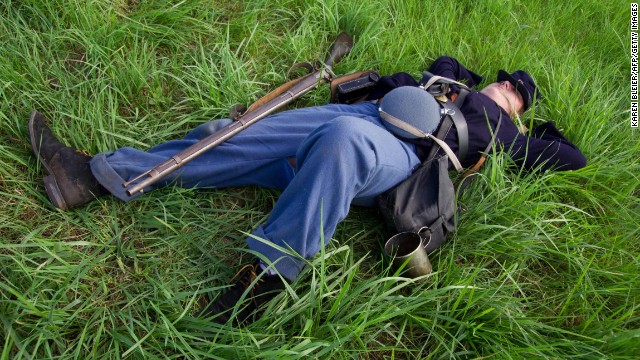
(CNN) — “For every Southern boy fourteen years old, not once but whenever he wants it, there is the instant when it’s still not yet two o’clock on that July afternoon in 1863.”
So starts a powerful passage by William Faulkner in “Intruder in the Dust.” The Mississippi novelist and poet poignantly painted the scene of dry-mouthed young men anticipating battle.
But the Confederate attack, known in the annals of history as Pickett’s Charge, ended about a mile away in failure, gray-clad troops blunted by determined Union troops at Gettysburg, Pennsylvania.
Those young boys recalled by Faulkner were stopped at the Angle, a stone wall considered the high-water mark of the Confederacy — perhaps the last chance for victory in the U.S. Civil War. Instead, the Union prevailed at Gettysburg, a turning point in the four-year war that claimed at least 620,000 lives.
This weekend and through July 7, between 200,000 and 300,000 visitors — more than the number of combatants — will flock to the town and fields of Gettysburg National Military Park to mark the 150th anniversary of the three-day clash, which cost an incredible 51,000 casualties.
Pickett’s Charge will be the climactic event of a large re-enactment this weekend outside of park boundaries. On July 3, the actual anniversary of the attack, National Park Service rangers will guide thousands of visitors in loose formation across a gently rolling field. Others will stand where Federal regiments poured rifle and artillery fire into the arc of Confederates.
The event ends with the playing of Taps by multiple musicians, a solemn remembrance of selfless sacrifice by the warriors at Gettysburg.
Times have changed since previous anniversary observances, including the 1938 reunion, at which grizzled veterans of the battle met at Gettysburg one last time in an event known for reconciliation. They shook hands across that famous wall at the Angle. Some let out the haunting Rebel Yell.
The 150th commemoration of the battle will tell a wider story than previous observances, officials told CNN.
“For decades, people came here for military and black powder,” said Carl Whitehill, media relations manager for the Gettysburg Convention & Visitors Bureau. “Now they want to know about the civilians and what they endured during and after the battle.”
Mike Litterst of the National Park Service said interpretations at federal Civil War battlefields have evolved in the past 25 years. Besides telling the story of the battles and the homefront, exhibits increasingly stress the importance of the conflict to civil rights and the role of African-Americans, thousands of whom served in the Union Army.
About 400 events are planned over 10 days, including a second battle re-enactment next weekend.
Gettysburg National Military Park on Sunday will hold one of its 150th anniversary signature events, an evening program entitled“Gettysburg: A New Birth of Freedom.” The keynote speaker is historian Doris Kearns Goodwin. Country music singer Trace Adkins and a military band will perform the national anthem.
The ceremony concludes with a procession to the Soldiers’ National Cemetery, where luminaries will mark each of 3,500 graves of soldiers who died at Gettysburg.
“I think it is an opportunity for people to have a deeper understanding of what happened here and how it is still relevant in 21st century America,” said Litterst.
Small town made way into history books
Gettysburg, then a bucolic town of 2,400 souls, found itself directly drawn into the Civil War during the first days of July 1863. Southern troops took the war to the North after a resounding victory at the Battle of Chancellorsville two months before.
Gen. Robert E. Lee’s soldiers on the first day of battle pushed Union troops through the town and onto hills and ridges that eventually played a large part in the battle’s outcome.
“There was street fighting in the inside (of Gettysburg),” said Whitehill. “Throughout the town, a lot of people were shooting muskets out of windows.”
Jennie Wade, while kneading dough, was fatally shot in the back on July 3, the only civilian casualty at Gettysburg,
Gettysburg, now with a population of about 7,800, and surrounding Adams County anticipate a $100 million economic impact from 150th anniversary observances.
Whitehill has spent much of his time assisting nearly 700 journalists from across the United States and abroad. Among international media are German, UK, Australian and Swiss companies.
“One of the things that amazes international visitors and media is why we re-enact this war. It is such a pivotal and painful time for this country but every year we bring it to life and re-enact it.”
The area’s 2,600 rooms and 1,800 campsites are largely filled, although a few are left.
“A lot of people move to this area for the history,” said Whitehill. “A lot of people just love being close to it.”
First aid tents all over town will assist any visitors and event participants who run into problems from the muggy and warm temperatures.
Visitors can take free shuttles into downtown and re-enactments. The National Park Service also offers shuttles and satellite parking.
Traffic flow on Friday, the first full day of 150th events, went well.
Thousands of re-enactors go back in time
Don Ernsberger led the building of a replica Pickett’s Charge stone wall for this weekend’s re-enactment at Bushey Farm.
Seventy volunteeers shaped 88 tons of stone to re-create the focal point of the march.
“The Confederates captured that angle for about five to eight minutes and the Union reinforcements came in and pushed them out.”
Ernsberger, who authored a book about the wall and the attack, will portray a Union lieutenant on Sunday.
“I wrote this book three years ago and I hope to see it happen before my eyes,” he said.
An estimatetd 10,000 re-enactors are on hand at Bushey Farm this weekend, said Kris Shelton, media and marketing coordinator for the Blue Gray Alliance, which is sponsoring the event.
The first mock battle went well Friday, said Shelton, who said organizers have detailed logistics plans for the maneuvering of troops at the site.
There’s a chance of rain for the next several days.
“We are historically accurate, but we don’t control the weather,” Shelton said.
Organizers expect tens of thousands of spectators on Saturday and Sunday.
Besides portrayals of the fighting, the re-enactment will include about 200 individuals representing the town of Gettysburg in 1863.
“The civilians living there have done careful research of the residents of the town and they have taken on their identities, including their trade and craft,” said Shelton.
Safety of participants and guests comes first, but authenticity also is a priority.
“People are here to recognize and honor and commemorate what these people went through, the sacrifices of both soldiers and civilians,” said Shelton.
The battles draw re-enactors devoted to donning the proper uniforms and equipment. They can get caught up in the heat of the battle and emotional or significant moments.
“That intensity is something that really sparks re-enactors,” she said. “That combined with leaving electronics and the modern world behind.”
Visitors and participants alike understand that real people died in battle — that freedom had a cost.
Making the battlefield historically accurate
While battle re-enactments are not permitted on National Park Service sites — the commemorative clashes will be on privately owned land — such events and the visitor experience at Gettysburg National Military Park are “not mutually exclusive,” said Litterst.
“We want that excitement to spill over to the sites and grounds where the events actually took place,” he said.
The National Park Service does not provide crowd estimates or projections, but it’s clear the park will be busy over the next week, given ranger-led hikes and special programs.
“We will probably see crowds we probably haven’t seen before, or since the centennial,” said Litterst. “For the next couple weeks, there won’t be many places to get some alone time here.”
But for those who want to get away from at least some of the hustle and bustle, he recommends a visit to the East Cavalry Battlefield Site east of town and the park’s Big Round Top, which has a great walking trail.
The battlefield looks much different from even 20 years ago as the NPS worked to make it look much closer to its 1863 appearance. Trees have been removed in some places and orchards planted.
Thousands may make the July 3 Pickett’s Charge commemorative march, timed to the actual assault.
Those with younger legs may be in front. And, like battles of old, there will be stragglers.
“There will be not be a shortage of people with stories and pictures of great-great grandfathers who made that march,” said Litterst. “That is a neat part of the story.”
Scientists around the world have been tracking the promising Comet ISON because of its potential to star in a spectacular celestial show later this year, but from now through Aug. 8 the comet is on a “summer sabbatical.”
Comet ISON — which some have hailed as the next “comet of the century” — is currently located too near the sun to be seen from Earth. Since June 22, the comet has been less than 18 degrees from the sun and therefore cannot be seen against a dark sky. Your closed fist held at arm’s length covers about 10 degrees of the sky.
Currently located against the stars of the zodiacal constellation of Gemini, or the twins, the comet is progressing slowly eastward and will cross over into the boundaries of Cancer, the crab, on Aug. 1. A week later, on Aug. 8, the comet will have moved out as far as 18 degrees from the sun and once again will be evident against a dark sky. [See Photos of Comet ISON in Night Sky]
Comet ISON has brightened little, if at all, since the start of 2013, and when last seen was hovering at magnitude 15.5, making it nearly 4,000 times too dim to be seen with the unaided eye.
To readily observe the dim, fuzzy blob of ISON prior to June 22, you would have needed a very dark sky and a telescope with at least 20 inches (50.8 centimeters) of aperture, if not more. Comet ISON is too close to the bright twilight, but that will change after the first week of August as ISON — then a morning object — begins a slow emergence into the morning sky.
Both amateur and professional astronomers will have their fingers crossed that by early August ISON will have shown significant brightening since it was last seen in late June.
Mercury will be passing 4 degrees south of the comet on Aug. 8 and might be used to steer an observer toward ISON. But, by then, the comet will still be rather faint — probably about magnitude 13, although it might reach to magnitude 11 or even 10 by the end of August. Astronomers use a number-based magnitude scale to determine the brightness of objects in the night sky. The lower the magnitude number, the brighter the object.
With Comet ISON’s brightness apparently stalled as it disappeared into the glare of the sun, it’s anybody’s guess just how bright the object will shine when it reappears in early August.
The unpredictability of how bright a new comet may appear or how bright it ultimately gets is no surprise to those who constantly study these enigmatic objects. There are many variables that go into determining what ultimately will be seen: the comet’s orbit; the relative positions of the sun, Earth and comet; and, of course, the size and composition of the icy chunk of material that forms the comet’s nucleus.
One reason it’s so hard to predict a comet’s brightness is that the material expelled from the object’s nucleus usually comes in distinct, albeit non-uniform jets or emissions. From more than a century’s worth of observations, astronomers have developed general formulas and models for comet brightness based on the observed behavior of literally hundreds of comets.
But some comets, like people, have their individual quirks.
It is hypothesized that ISON appeared abnormally bright during its discovery by amateur astronomers in September 2012 because it possessed a thin “frosting” of volatile material that vaporized at a great distance from the heat of the sun. This may have initially given a false impression that the object was dynamically large and active. After the frosting evaporated, the comet stopped brightening.
As to what happens next, observers now must wait until the comet gets close enough to the sun for any frozen water locked within its 3-mile-wide nucleus to begin to sublimate (go from a solid to a gaseous state). This, in turn, could “kick start” ISON back on a brightening trend.
ISON will need to come to within 230 million to 280 million miles (370 million to 450 million kilometers) of the sun for this to happen, but the comet won’t arrive within this distance range until July 8 to Aug. 12.
By the latter date, ISON will have emerged into a dark sky and will again be assessable to observers, low in the east-northeast sky, just before the break of dawn.
Will it have brightened or will it still be “stuck?” Observers will just have to wait and see.
Joe Rao serves as an instructor and guest lecturer at New York’s Hayden Planetarium. He writes about astronomy for Natural History magazine, the Farmer’s Almanac and other publications, and he is also an on-camera meteorologist for News 12 Westchester, N.Y. Follow us on Twitter, Facebook and Google+. Original article on SPACE.com.
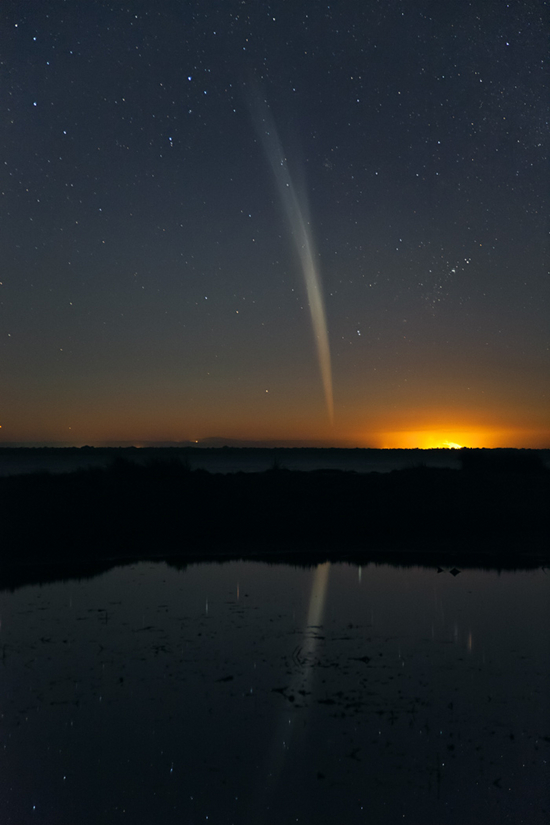
Here are the back-of-the-envelope numbers for June 27, 2013.
Today, Comet ISON is approximately 3.16 AU from the sun. There are still 154 days until Comet ISON reaches perihelion.
Over the course of the past 10 days, Comet ISON traveled a distance of approximately 0.135 AU.
0.135 AU = 12,549,034 mi
0.135 AU = 20,195,712.5 km
That’s an average speed of roughly 1.25 million miles per day, or 2.02 million kilometers per day.
Between June 26, 2013 and June 27, 2013, ISON traveled a distance of approximately 0.013 AU. This is fairly consistent with the numbers seen 10 days ago.
0.013 AU = 1,208,425.49 mi
0.013 AU = 1,944,772.32 km
That’s an average speed of roughly 50,351 mph or 81,032 km/h. That’s approximately 13.99 mi per sec or 22.51 km per sec.
Here are two news snippets from the past week.
Astronomers had predicted Comet ISON would have started to brighten by now but it has stayed constant. Right now the comet is out of observation range behind the sun in the asteroid belt. When observations begin again in August, astronomer David Schleicher explains they can see if it has brightened as expected.
– Arizona Daily Sun, June 22, 2013
Geoff Chester, a spokesman for the U.S. Naval Observatory in Washington D.C. said: “Predicting a comet’s appearance five months before it arrives is like predicting November’s weather now. There’s a lot of room for error, so it may be wise to acknowledge you don’t really know.”
– The News-Times, June 21, 2013
Looks like this former Conrail CW40-8 had a bit of a problem going down the road. Picture from NS locomotives Facebook page.


From Kristen Nelson’s Blog
What I’ve seen in the last 2 weeks and why I passed:
4 Full Manuscripts (2 with offers of rep on the table)
1 – New Adult/wm’s fic. Recommended by a former editor we know well and like. I totally enjoyed the writing but for me, the story didn’t have a foot solidly in one genre or the other. I didn’t have the vision/passion for it so I passed.
2 – Wm’s fic/erotic leaning. Probably one of the more interesting concepts for a story that I’ve seen in a long time. What was interesting is the writing was quite literary but if I were to explain the plot, it would feel like contemporary romance. I went back and forth on that one as so intriguing. I did end up passing despite how smartly it was done.
3 – Middle Grade. Great great concept. But I had reservations that the voice didn’t quite nail the middle grade age range and although cool, a lot of the story felt too sophisticated but not exactly right for YA either.
4 – Middle Grade. Multicultural main character which I love. Great MG voice. Story line needed some work and with my current work load, I was afraid I couldn’t give the author the attention deserved.
5 Sample Pages
1 – Adult literary. Too literary for what I can be successful with. But terrific writing and a wonderful multicultural story.
2 – Young adult. Previously published author with great background. Fun paranormal. Snappy writing. I liked it but didn’t love it.
3 – Adult steampunk. Author had very cool background and the writing was nice but the opening didn’t grab me.
4 – Adult literary. Same as the other above. Too literary for what I tend to have success with. Wonderful multicultural angle though.
5 – Contemporary romance. Previously published author with great backlist and background. I liked it but didn’t love it. With a full client list, it makes a difference on what I’ll take on.
Commentary from the mind of the artist
A Story Begins



 Talia's World