Pacific Rim Needs Our Help

Per TGDaily.com

Posted July 11, 2013 – 09:50 by David Konow

We just reported on the critical response to Pacific Rim, which so far has been mixed. There are critics that liked it, some who thought it was okay, and at least one overall negative review, which to be fair didn’t say the movie was dreadful, but it didn’t say it was anything to get excited about either.

You know from reading TGD that the geeks will be out in force to see Pacific Rim this weekend, yet even though the geeks are a force to be reckoned with, a movie can’t survive on geeks alone. In fact, the box office pundits have been predicting doom for Pacific Rim, even though its buzz is nowhere near as deadly as The Lone Ranger, or last year’s mega stink bomb Battleship.
How do these people know it’s going to bomb before it comes out? By tracking all the data, which isn’t always infallible. Variety headlined their story, “Pacific Rim Looking Grim With $25 Million – $35 million Opening,” noting that “Warner Bros. are bracing for what appears to be a gruesome inevitability” of potential low gross.
As The Wrap points out, this has been a particularly rough summer for movies, and this could potentially be the fourth week in a row of big screen bombs. Yet, on the other hand, as Variety also reports, Pacific Rim has gotten a very strong 85% positive rating on Rotten Tomatoes, with a 98% rating of people who want to see it this weekend.
So definitely get out there and give Pacific Rim your support. It’s Guillermo Del Toro’s big return to the theaters, and it looks like it could be great fun. Hollywood may be panicking that it may not have a huge opening weekend, but perhaps word of mouth can make Pacific Rim a winner if the fan response is enthusiastic enough.

Read more at http://www.tgdaily.com/games-and-entertainment-features/72432-pacific-rim-needs-your-help#XhIPjEmXkI1d1oH2.99

Wegmans cuts health benefits for part-time workers

And here’s the first major domino to fall. There will be more as we get closer to January 1, 2014. While the rich, and the powerful will have access to their own private health care options, the average Joe will be saddled with high cost insurance-and eventually government run insurance. This will cut the quality of care for us average people down to unacceptably poor levels while the elite keep theirs. Same song, same dance with the ‘climate change’ bullshit. They want everyone living in the cities, where we’re easy to control, while they move out of the countryside and enjoy the nice open spaces that we, the great unwashed masses, aren’t smart enough or powerful enough to possess. And never forget this: the big boys aren’t going to give up their million dollar bonuses to look out for us either.

Per the Buffalo News:

By Samantha Maziarz Christmann | News Staff Reporter | @DiscountDivaSam

on July 10, 2013 – 11:57 PM

, updated July 11, 2013 at 11:20 AM


Et tu, Wegmans?

The Rochester-based grocer that has been continually lauded for providing health insurance to its part-time workers will no longer offer that benefit.

Until recently, the company voluntarily offered health insurance to employees who worked 20 hours per week or more. Companies are required by law to offer health insurance only to full-time employees who work 30 hours or more per week.

Several Wegmans employees confirmed part-time health benefits had been cut and said the company said the decision was related to changes brought about by the Affordable Care Act.

However, part-time employees may actually benefit from Wegmans’ decision, according to Brian Murphy, a partner at Lawley Benefits Group, an insurance brokerage firm in Buffalo.

“If you have an employee that qualifies for subsidized coverage, they might be better off going with that than a limited part-time benefit,” Murphy said.

That’s because subsidized coverage can have a lower out-of-pocket cost for the insured employee while also providing better benefits than an employer-paid plan.

Under the Affordable Care Act, part-time employees are not eligible for health insurance subsidies if their employer offers insurance.

“It’s a win-win. The employee gets subsidized coverage, and the employer gets to lower costs,” Murphy said.

“As a private company, we don’t share specifics of our employee benefits programs. It’s a given that health care reform will result in some changes to our benefits program, but it will not change our commitment to meeting the needs of our employees,” Wegmans said in a statement.

Wegmans declined further comment.

Wegmans employs roughly 1,433 full-time employees and 4,304 part-time employees in the Buffalo Niagara region.

email: schristmann@buffnews.com

Judge rules Apple conspired to raise prices on e-books

Reuters – 13 minutes ago

By Nate Raymond and Jonathan Stempel

NEW YORK (Reuters) – In a sweeping rejection of Apple Inc’s strategy for selling electronic books on the Internet, a federal judge ruled that the company conspired with five major publishers to raise e-book prices.

U.S. District Judge Denise Cote in Manhattan found “compelling evidence” that Apple violated federal antitrust law by playing a “central role” in a conspiracy with the publishers to eliminate retail price competition and raise e-book prices.

Wednesday’s decision could expose Apple to substantial damages. It is a victory for the U.S. Department of Justice and the 33 U.S. states and territories that brought the civil antitrust case. The five publishers previously settled.

Apple was accused of pursuing the conspiracy to undercut online retailer Amazon.com Inc’s e-book dominance, causing some e-book prices to rise to $12.99 or $14.99 from the $9.99 that Amazon charged. Amazon once held a 90 percent market share.

“Apple chose to join forces with the publisher defendants to raise e-book prices and equipped them with the means to do so,” Cote said in a 159-page decision. “Without Apple’s orchestration of this conspiracy, it would not have succeeded as it did.”

The decision was not a total surprise. Cote indicated before the 2-1/2 week non-jury trial began on June 3 that Apple’s defenses might fail. The judge on Wednesday ordered a trial to set damages.

“This result is a victory for millions of consumers who choose to read books electronically,” Bill Baer, head of the Justice Department’s antitrust division, said in a statement. “This decision by the court is a critical step in undoing the harm caused by Apple’s illegal actions.”

Baer said Cote’s decision, together with the earlier settlements, help consumers by reducing prices of e-books. Barnes & Noble Inc also competes in that market.

In a statement, Apple said it will appeal Cote’s decision.

“Apple did not conspire to fix e-book pricing,” spokesman Tom Neumayr said. “When we introduced the iBookstore in 2010, we gave customers more choice, injecting much needed innovation and competition into the market, breaking Amazon’s monopolistic grip on the publishing industry. We’ve done nothing wrong.”

Last year, Apple settled a separate antitrust case over e-book pricing with the European Commission, without admitting wrongdoing.

IMPACT

The alleged collusion began in late 2009 and continued into early 2010, in connection with the Silicon Valley giant’s launch of its popular iPad tablet.

Only Apple went to trial, while the publishers agreed to pay more than $166 million combined to benefit consumers.

The publishers included Lagardere SCA’s Hachette Book Group Inc, News Corp’s HarperCollins Publishers LLC, Pearson Plc’s Penguin Group (USA) Inc, CBS Corp’s Simon & Schuster Inc and Verlagsgruppe Georg von Holtzbrinck GmbH’s Macmillan.

Geoffrey Manne, who teaches at Lewis & Clark Law School in Portland, Oregon, said Cote’s decision may not change the e-books market much because of the earlier settlements with publishers, which ended their pricing arrangements with Apple.

“To the extent the remedy might be behavioral constraints in the e-books market, the settlements with publishers already deal with that,” Manne said.

In afternoon trading, Apple shares were down 52 cents at $421.83 on the Nasdaq.

Steve Berman, a partner at Hagens Berman Sobol Shapiro pursuing consumer class-action litigation against Apple, called Cote’s decision “a very big deal.”

“It exposes Apple to hundreds of millions of dollars in damages, which is what we’ll ask for,” Berman said.

Apple ended March with nearly $145 billion of cash and marketable securities. It plans to spend $100 billion on share buybacks and higher dividends through 2015.

STEVE JOBS

Amazon’s strategy involved buying e-books at wholesale and then selling them at below cost, in an effort to promote its Kindle reading device.

Apple, in contrast, entered into “agency agreements” in which publishers were able to set prices, and pay 30 percent commissions to the Cupertino, California-based company.

The federal government said this arrangement pushed Amazon into a similar model, and resulted in prices of e-books from the five publishers increasing by 18 percent.

“What happens next may depend on Amazon,” said Keith Hylton, a Boston University law professor and antitrust specialist. “If Amazon feels a need to keep driving e-book prices down to maximize Kindle sales, it could put downward pressure on prices overall, and perhaps help Amazon win market share back.”

Amazon spokesman Drew Herdener declined to comment.

Evidence in the case included emails from Apple’s late co-founder Steve Jobs to News Corp executive James Murdoch that the government said reflected Jobs’ desire to boost prices and “create a real mainstream e-books market at $12.99 and $14.99.”

Those emails hurt Apple’s case.

“Apple has struggled mightily to reinterpret Jobs’s statements in a way that will eliminate their bite,” Cote said. “Its efforts have proven fruitless.”

Cote also rejected Apple’s argument that it would be unfair to single out the company when Amazon and Google Inc, among others, entered similar agency agreements with publishers.

Apple had argued that it never even understood that publishers might have talked among themselves about higher prices before the iPad launch.

“There is no such thing as a conspiracy by telepathy,” Apple’s lawyer Orin Snyder said in closing arguments on June 20.

The decision allows the plaintiffs to seek injunctive relief to prevent further pricing conspiracies.

At trial, the Justice Department said it wanted to block Apple from using the agency model for two years. It also wants to stop Apple over a five-year period from entering contracts with clauses designed to ensure it offers the lowest prices.

The case is U.S. v. Apple Inc et al, U.S. District Court, Southern District of New York, No. 12-02826.

(Reporting by Nate Raymond and Jonathan Stempel in New York; Additional reporting by Alistair Barr; Editing by Gerald E. McCormick and John Wallace)

No penalties for altered roof flaps

Now I’ll explain later why this was a pure smokescreen for something that NASCAR did behind the scenes. Now, when I explain it, keep an open mind and realize I’m speaking business wise, ok? Even sports associations have business plans.

the-2013-nascar-ford-fusion-racing-for-the-green-1239x743


CHARLOTTE, N.C. — NASCAR announced on Wednesday there will be no penalties for the 31 teams caught with altered roof-flap spacers last weekend at Daytona International Speedway.

NASCAR confiscated the roof flaps, designed to keep cars on the ground during wrecks at high speeds, from 16 Sprint Cup teams and 15 Nationwide Series teams before Thursday’s practices.

Officials said the roof-flap spacers had been machined down to reduce weight in the roof of the car.

Teams and manufacturers, according to the NASCAR rulebook, must be installed as specified in the instruction sheet supplied with the hinged air deflector kit. Teams were allowed to replace the spacers that attach to the hinge of the roof flaps to meet specifications.

Because the governing body frowns on alterations to parts, particularly when they apply to safety devices, many teams expected penalties.

“We examined this from every aspect we possibly could and determined that there would be no penalties involved,” NASCAR vice president of competition Robin Pemberton said in a statement. “Based upon our inspection and subsequent review it was our determination that the functionality and safety aspects of the roof flaps were not compromised and the on-track competition would not be impacted.

“Moving forward we will work with the roof flap manufacturer and the race teams to evaluate and optimize the associated installation hardware, review the process in its totality and communicate in a timely manner to the garage area any revisions that we determine need to be made.”

The Cup drivers whose cars had the altered spacers were: Kyle BuschDenny HamlinMatt KensethGreg BiffleCarl EdwardsRicky Stenhouse Jr.Clint BowyerMartin Truex Jr.,Michael WaltripJoey LoganoBrad KeselowskiTrevor BayneCasey MearsJamie McMurrayMarcos Ambrose and Aric Almirola.

Jimmie Johnson won the race in a Hendrick Motorsports car, none of which were found to have the spacers.

‘Pacific Rim’ Looking Grim With $25 Million-$35 Million Opening

Per Variety.com

After spending the past two weeks trying to turn the tide for “Pacific Rim,” Warner Bros. and Legendary Pictures now are bracing for what appears to be a gruesome inevitability for the $185 million-plus monster movie: A domestic opening ranging between $25 million and $35 million.

This weekend could be the second in a row in which an expensive non-sequel property bellyflops at the box office after “Lone Ranger” flamed out last weekend.

The impending doom has been pretty clear ever since “Pacific Rim” came on tracking early last month. And while there are certainly some last-minute hopeful signs for Warner and Legendary to cling to (i.e. strong reviews and unreliable tracking lately), there’s little chance that “Pacific Rim” will open well enough in the U.S. to counter its monster-sized budget and marketing costs.

FILM REVIEW: “Pacific Rim”

But before we delve into the negative, there are a few possible bright spots:

  • Positive reviews. As of Tuesday afternoon, the film has scored an 85% rating on RottenTomatoes, with a 98% rating among audiences who want to see the film. Exhibitor reactions to the film also have been better than expected.
  • Overseas. Warner launches “Pacific Rim” in 38 day-and-date territories, including the U.K., Mexico, Russia, South Korea, Italy and Australia.
  • Skewed tracking. “Pacific Rim” straddles the line of being a fanboy and family film, with heavy interest among boys, and tracking for younger auds is notoriously unreliable. Does that mean the film can double current projections? No.
  • Holiday frenzy. The buzz surrounding the Fourth of July weekend was still humming on Monday, when NRG — the most subscribed-to tracking service — released its most current weekend estimates. The company will revise those estimates Thursday.

All of those factors weigh in “Pacific Rim’s” favor, particularly the first, after Paramount managed to parlay strong early reviews for “World War Z” into a surprising $66 million domestic opening.

SEE MORE: Is ‘Pacific Rim’ Doomed to Be This Year’s ‘Battleship’?

But to be clear, an opening like that is not in the cards for “Pacific Rim” — not with competition from “Despicable Me 2″ and “Grown Ups 2,” both of which also have strong family appeal. Observers predict that “Despicable Me 2″ will win its second frame in the high-$40 millions, while “Grown Ups 2″ is expected to gross in the low-$40 million range. Both “Grown Ups 2″ and “Pacific Rim” are rated PG-13.

For “Pacific Rim,” which is a passion project for helmer Guillermo del Toro, the early July release date was likely modeled after “Transformers,” which opened with $70 million in 2007. That’s the kind of start Legendary expected to see when it greenlit the pricey ensemble project about an apocalyptic battle between aliens and robots created to fight them. But without a major star toplining the film, Warners — which came on board later to help finance 25% of the production cost — had to market the film based solely on the original concept. The studio only recently began highlighting the pic’s humor and lighter elements to help draw interest.

SEE MORE: How Legendary Is Trying to Turn Around Troubling Tracking for ‘Pacific Rim’

Tracking for the film outside the U.S. is strongest in Asia, with the area’s long history of creature features, but the pic is seeing only moderate interest in other parts of the world.

Some celebrities, including Kanye West, have taken to social media with positive reactions to the film. Videogame design icon Hideo Kojima also expressed his admiration in a tweet saying, “This film is not simply a film to be respected, but most importantly, it let us dream the future of entertainment movies.”

The film’s grim financial outlook notwithstanding, Kojima may have a point. If only the film’s budget could have been kept in check.


Oil prices surge above $105, gasoline tops $3.50

None of the reasons for this are legit. It’s nothing more then greed on the parts of both OPEC and the Oil Companies. Ever notice that whenever gas get’s near 3 bucks a gallon that the price of oil shoots up again? Next thing you know, it’s back to 3.50-3.70. It’s nothing more than the companies making sure it stays at one price. How in the name of God can a stagnant economy pull down reserves that were so full you couldn’t swing a car without hitting a barrel of oil? By artificially bringing it down that’s how.

130710111619-crude-oil-2weeks-620xa


NEW YORK (CNNMoney)

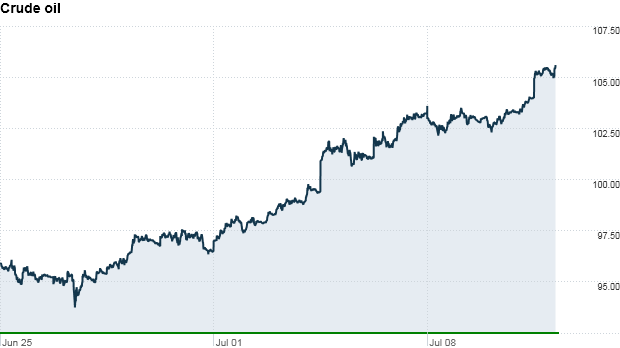
U.S. oil prices jumped above $105 a barrel Wednesday, their highest level in over a year, as stockpiles of crude dwindled and tensions in Egypt kept traders on edge. Gasoline prices in the United States also began to move higher.

Oil prices rose nearly $2 a barrel following a report from the American Petroleum Institute showing a 9 million barrel draw down in crude oil stored in tanks around the country.

The $2 rise comes on top of gains made over the last couple of weeks after widespread protests and a military takeover in Egypt. U.S. oil prices are up 10% since the end of June.

The rise in crude prices is beginning to make its way into the cost of gasoline. After falling for several weeks, average gas prices in the United States ticked up 2 cents a gallon overnight to $3.50.

“There are going to be a lot of unhappy people if gas prices continue to rise quickly in the coming days,” Michael Green, a spokesman for AAA, said in a press release Wednesday. “This is among the busiest times of the year for driving and no one wants to pay more to fill up their gas tank.”

Crude stockpiles: The draw down in crude oil supplies is partly the result of an upgrade to a giant BP (BCONQ) refinery in Whiting, Indiana. That upgrade now allows the refinery to process 250,000 more barrels of oil per day — oil that comes out of crude stockpiles.

But the larger picture is that the oil industry has gotten better at alleviating a glut of crude supplies, especially in the middle part of the country.

That glut was caused by the recent boom in U.S. oil production from places like North Dakota’s Bakken Shale and Texas’ Eagle Ford. The oil was being pumped, but the infrastructure to move it to market wasn’t in place. That led oil to pile up in places like Cushing, Okla. — home to the convergence of several pipeline, oil storage tanks, and the delivery point for the most widely cited U.S. oil contract — West Texas Intermediate.

As a result, for the last couple of years WTI prices were some 20% below other oil contracts traded both in the United States and globally –such as the North Sea’s Brent crude.

Related: Beware dire predictions on Obama’s war on coal

Over the last several months, new pipelines have opened and more oil is being moved by rail.

“It is clear that the various pipeline workarounds and rail shipments are having an effect,” Mike Fitzpatrick, editor-in-chief of Kilduff Report’s Energy Overview, wrote in a note Wednesday. “There is still plenty of oil in storage and being produced. But the facts on the ground in Cushing are changing.”

WTI prices are now nearly even with Brent prices — which is more the historical norm.

Egypt: The country itself doesn’t produce much oil. But it sits astride the Suez Canal, through which some 4 million barrels of crude oil and other petroleum products pass each day. Traders fear the unrest may disrupt that flow.

There’s also concern the events in Egypt — a populous country that’s considered a bellwether of Arab opinion — could spark broader protests across the Middle East and North Africa. The region is home to about a third of the world’s oil production.

Brent oil prices are up about 7% since the start of the violence.

The protests were sparked two weeks ago by millions of Egyptians unhappy with the increasingly authoritarian rule of the county’s democratically elected, Islamist President Mohamed Morsy. The military ousted Morsy last week, and the country has since descended into chaos that’s left scores dead.

Gasoline prices: While pump prices are on the upswing, they may not rise as far or as fast as oil prices, for several reasons.

First, the BP refinery, while taking oil off the market, will produce gasoline. That should add to national supply and help keep prices lower.

Second, While WTI prices have risen 10%, U.S. gasoline has always been made with a blend of crudes, not just WTI. So the rise attributed to the easing of the bottleneck in Cushing and elsewhere in the middle part of the country shouldn’t have too big an impact on gasoline prices, except perhaps in the Midwest.

Finally, while the unrest in Egypt may be propping up prices globally, there is little else in the way of solid economic news that would support oil prices at this level. Economic data out of China is looking particularly weak.

“With the move above $105, you may sell at will,” Fitzpatrick wrote in his note, meant for oil traders. “The slowdown in China cannot be denied and the market will adjust to the emerging Cushing dynamic.” To top of page